How to Set Up a WooCommerce Quote System for B2B and Wholesale Stores

Most wholesale stores do not lose deals because their prices are wrong. They lose deals because buyers have to email, wait, and follow up just to learn what a bulk order actually costs. That delay is the leak.

A WooCommerce quote system closes it by turning a slow back-and-forth into a structured, on-site request that lands in your dashboard the moment a buyer is ready to talk numbers. Today’s B2B buyers expect the same fast, self-service purchasing experience they receive as consumers.

This guide walks through what a WooCommerce quote system is, how to set one up step by step, and when a store owner should stop tinkering with plugins and bring in a specialist.

Why Manual Quoting Quietly Drains B2B Revenue

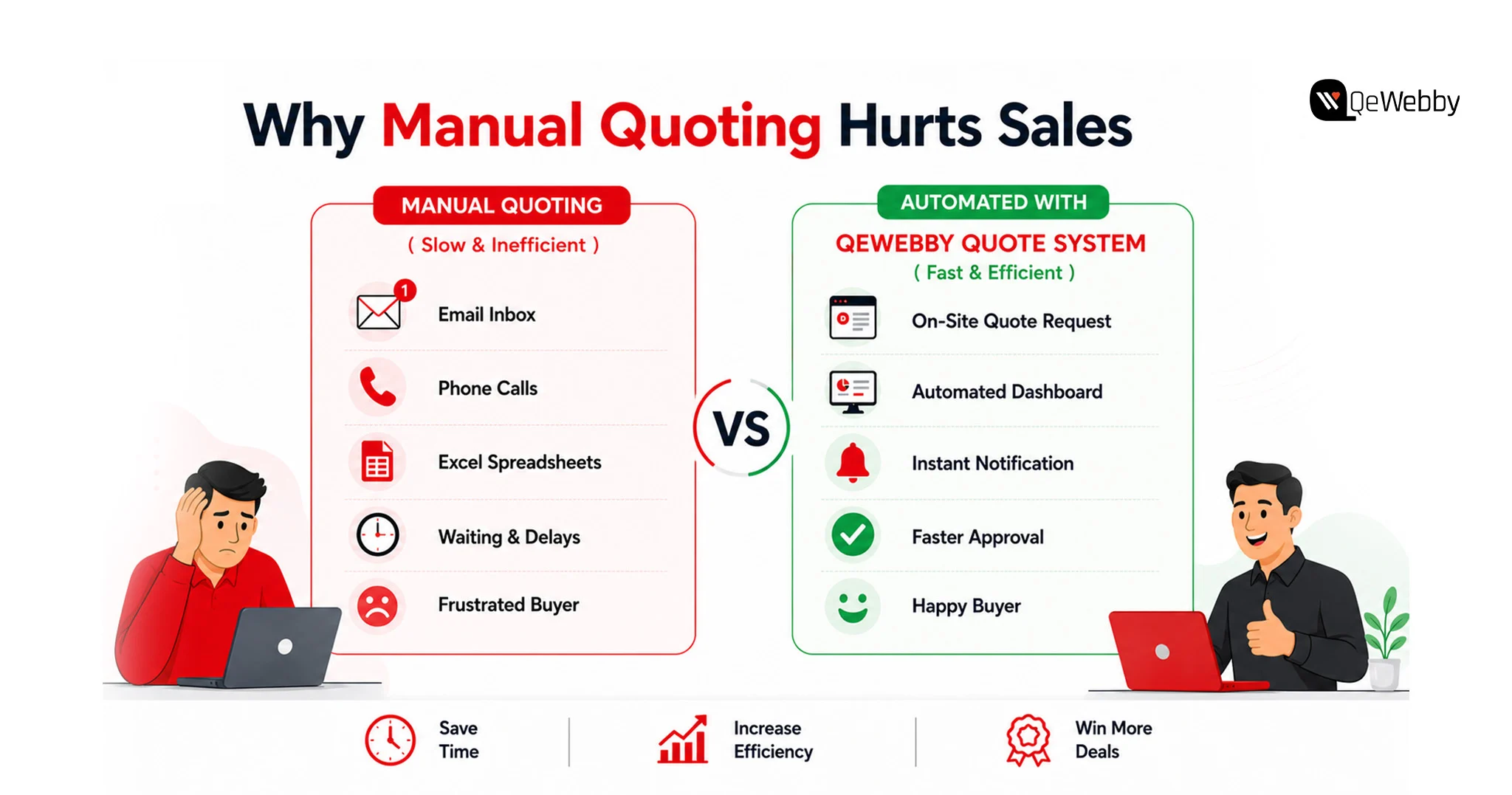
Manual quoting feels harmless. It is not. Every wholesale order routed through a rep’s inbox introduces delay, and delay is where B2B pipelines go to die.

The behavior shift is already measurable. Gartner found that 67% of B2B buyers prefer a rep-free buying experience, and 45% used AI during a recent purchase. Your buyer wants to self-serve. When your only path to a wholesale price is a phone call, you are fighting the way your market prefers to buy.

The market is not small, either. The B2B wholesale ecommerce market reached $32.1 trillion in 2025, roughly five times the size of B2C ecommerce, growing at a 14.5% CAGR. Digital channels now drive 56% of B2B revenue, up from 32% in 2020. The buyers are online. The question is whether your store captures them or sends them to a competitor who answers faster.

A WooCommerce quote system does not magically fix conversion. It removes the friction and lag that make a bad number worse, which is why a well-built WooCommerce quote system pays back fastest on high-value wholesale carts.

manual quoting hurt sales

What a WooCommerce Quote System Actually Is

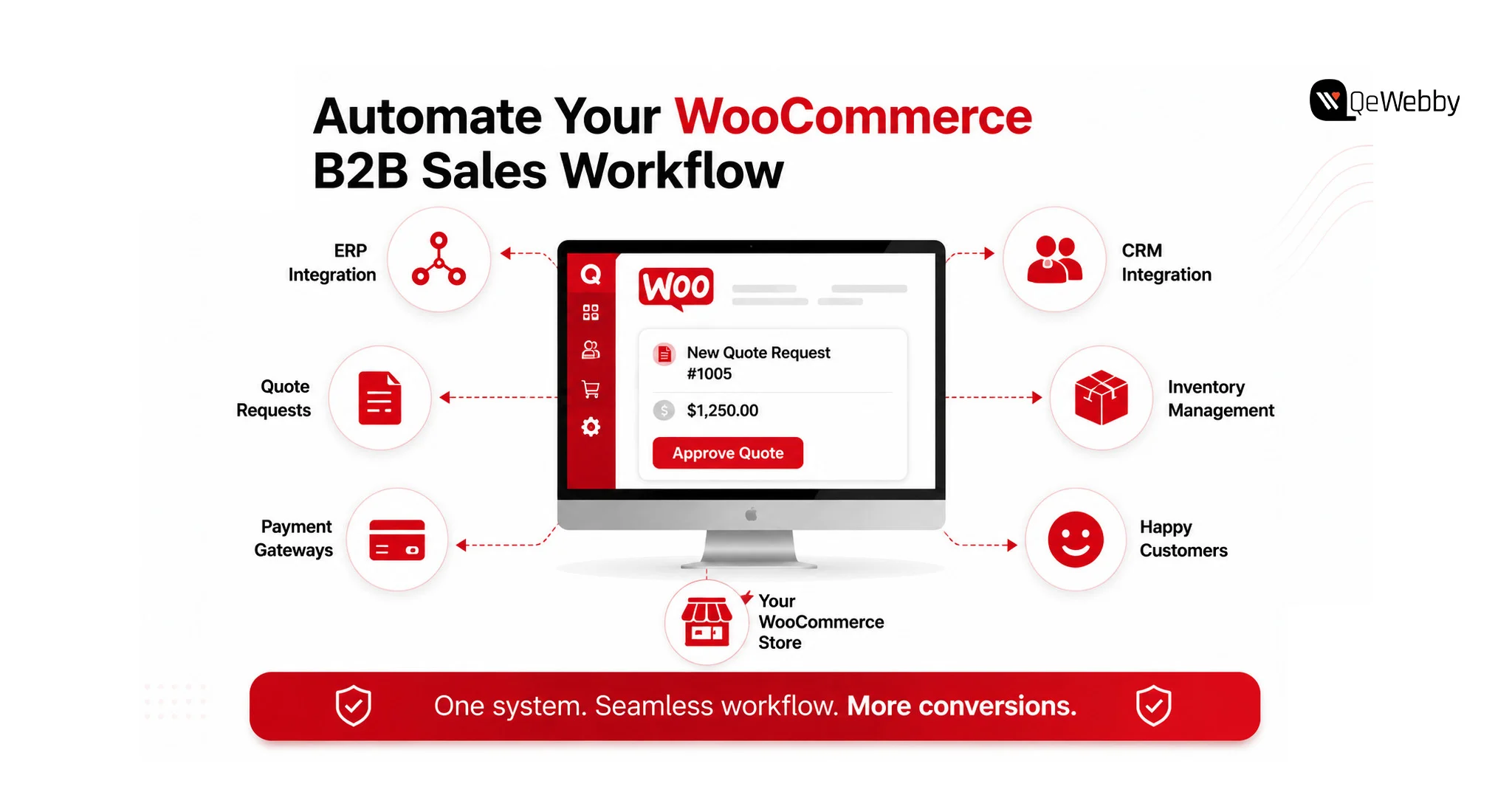
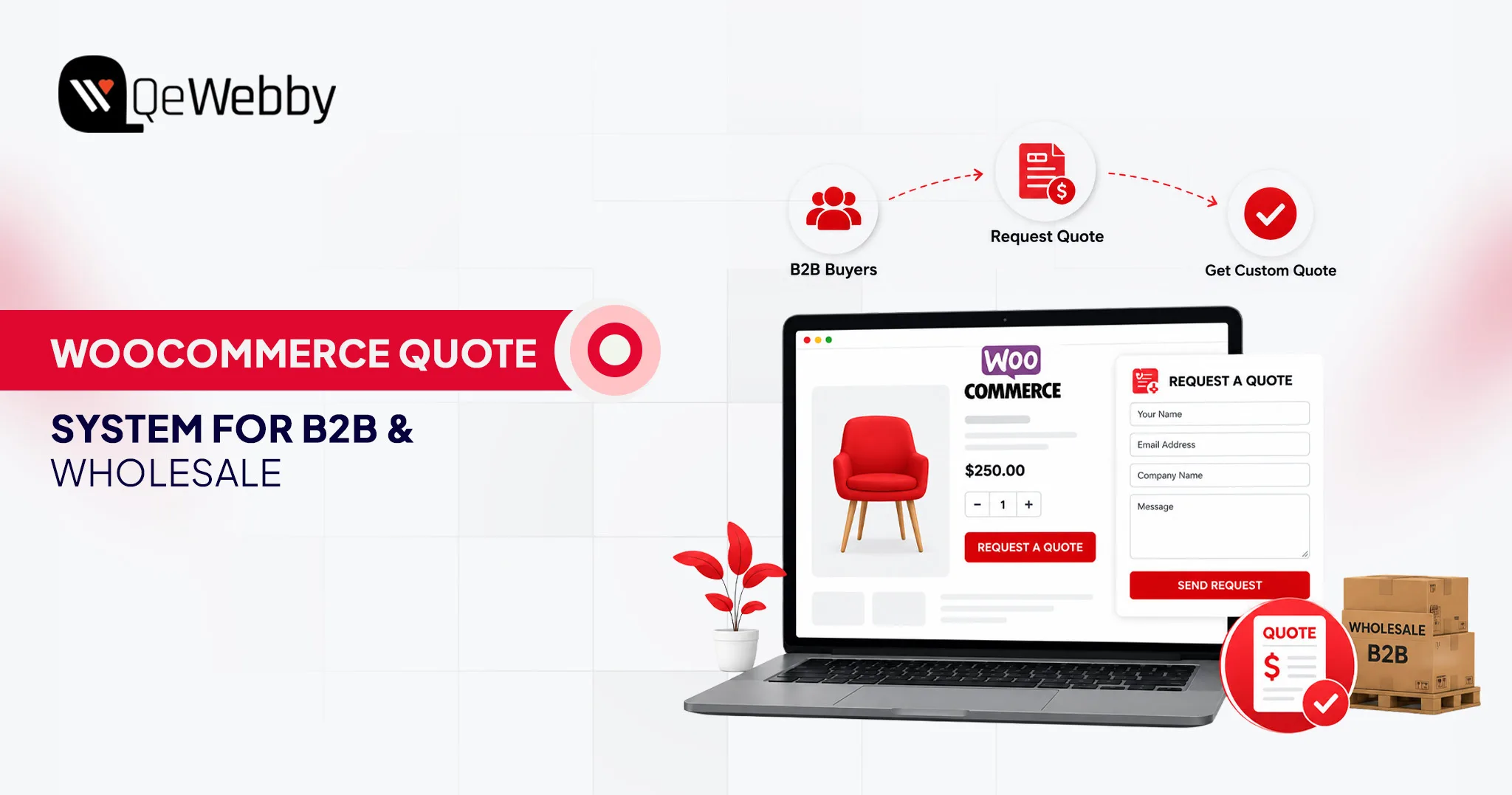
A WooCommerce quote system replaces the standard WooCommerce checkout with a structured “Request a Quote” workflow for selected products, customer groups, or user roles. The buyer creates a quote request, sends it and gets a custom quote from the store owner that the buyer can negotiate and place an order for.

Eliminate all the bells and whistles, and a WooCommerce quote system does four things. It places prices and/or the buy button in a location that you select. It collects quote requests that are directly linked to specific products, quantities, and customer information. Provides you with a dashboard to price, counter and approve each request.

And it turns an accepted quote into a typical WooCommerce order for payment. That last one is key, as it means your accounting, inventory and tax processing stay within the system you’re already using. This differs from a form where you type any information you want to send to the contact person. A form is a tool that gathers an e-mail message.

A WooCommerce quote system allows for the collection of intent related to particular SKUs, quantities, and customer role, and carries the intent through a defined pipeline. That’s what it is all about for wholesale and B2B. Just consider the WooCommerce quote system as a pipeline, as opposed to a form, and the rest of the setup is straightforward.

Book a free woocommerce audit

How to Set Up a WooCommerce Quote System Step by Step

Setting up a WooCommerce quote system is less about code and more about decisions. Who sees prices? Who can request a quote? What happens after they submit? Get those answers right, and the configuration is straightforward. The sequence below builds a working WooCommerce quote system in an afternoon, and it scales cleanly as your catalog grows.

Automate woocommerce workforce

Step 1: Choose and Install a Quote Plugin

WooCommerce does not ship quoting natively, so you install an extension. Strong options include the official Request a Quote for WooCommerce extension, YITH Request a Quote, the WebToffee Request a Quote plugin, and B2BKing for deeper wholesale control. Upload the plugin ZIP, activate it, and enter your license key. That is the entire install.

Step 2: Decide Where Quotes Replace Checkout

Now set the scope. Go into the plugin settings and choose which products trigger a quote request. You can enable quoting store-wide, for specific categories, or for individual SKUs. Most wholesale stores run a hybrid: retail products keep normal checkout, while bulk and made-to-order lines switch to a quote request. Do not enable it everywhere by default. Enable it where a custom price actually exists.

Step 3: Configure Role-Based Rules

This is where a WooCommerce quote system earns its keep. Rules-based plugins let you show different behavior to different user roles. Guest users might see hidden prices and a login prompt. Wholesalers see the quote button with prices hidden. Retailers keep prices, keep “Add to Cart,” and also get a quote option for large orders. Create a rule, name it, set its status to active, and define which roles and products it applies to.

Step 4: Build the Quote Request Form

The form is your data-capture layer. Use the plugin’s default form or connect Contact Form 7, Gravity Forms, WPForms, or Ninja Forms if you already run one. Capture what your sales team needs to price accurately: company name, quantity, delivery location, and any customization notes. Keep it short. Every extra field is a reason to abandon.

Step 5: Set the Quote Lifecycle and Expiry

Define what happens after submission. Incoming requests land in your dashboard under WooCommerce with a Pending status. You review, enter your offered price, and send the quote back. Set an expiry window, anywhere from one day to one month, so quotes match your sales cycle and create gentle urgency. A quote that never expires is a negotiation that never closes.

Step 6: Enable Quote-to-Order Conversion

The final step is the payoff. When a buyer accepts your quote, the plugin converts it into a standard WooCommerce order they can pay through your existing gateways. Confirm this conversion works end to end before launch. Test it as a buyer, accept a quote, and complete a payment. If that loop breaks, your WooCommerce quote system is a lead form, not a sales engine.

For a deeper walkthrough of individual plugin screens, WebToffee’s setup documentation covers the field-level configuration in detail.

Talk to woocommerce expert

How to Choose the Right Quote Plugin for Your Store

Not every plugin fits every store, and picking the wrong one means a rebuild six months in. The plugin you choose becomes the backbone of your WooCommerce quote system, so the decision comes down to how much B2B logic you need layered on top of the quote flow.

Requirement Lightweight plugin Full B2B suite
Hide the price and the buy button Yes Yes
Role-based quote rules Basic Advanced
Tiered wholesale pricing Limited Yes
Tax exemption and net terms Rare Yes
Quote-to-order conversion Yes Yes
Best for Simple quote capture Full wholesale portals
ERP Integration Limited Better

If you only need to hide prices and capture requests on a handful of products, a lightweight WooCommerce quote system is enough. If you are building a full wholesale channel with tiered pricing, tax exemptions, and net payment terms, a B2B suite saves you from stitching together five tools. The more instructive question is not which plugin has more features. It is how much of your pricing logic lives outside WooCommerce today, because that is what you will have to migrate in.

Configuring a WooCommerce Wholesale Quote System

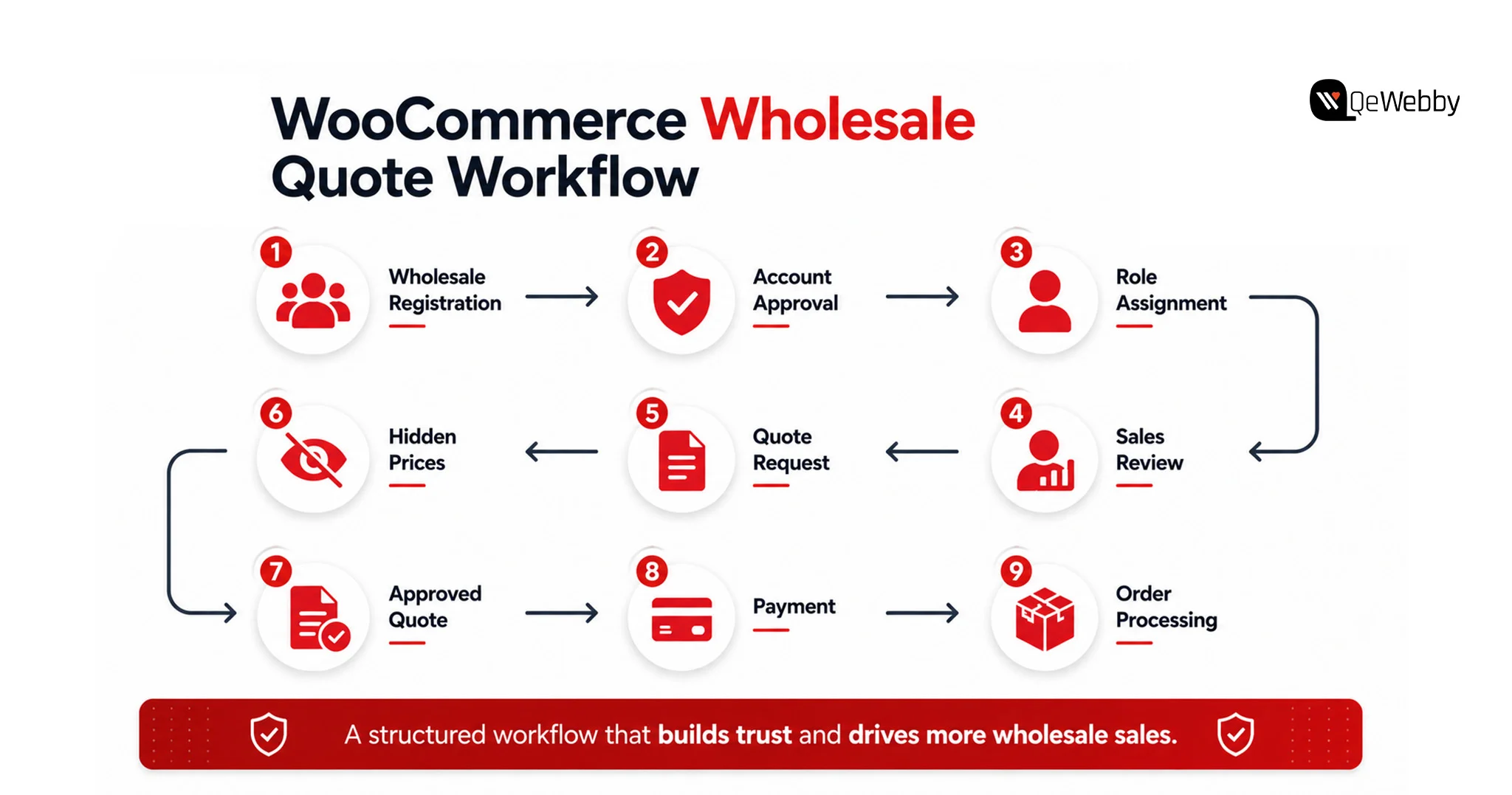
woocommerce quote workflow

A WooCommerce wholesale quote system is not just a quote form with a different label. Wholesale carries pricing logic that retail never touches, and a WooCommerce wholesale quote system has to account for all of it.

Start with customer roles. A proper WooCommerce wholesale quote system separates verified wholesale accounts from the public, so approved buyers see quote actions and tiered pricing while everyone else sees retail.

Add a wholesale registration and approval process because you do not want your trade prices visible to the open web. Layer in minimum order quantities on wholesale lines so a quote request reflects a realistic bulk order rather than a single unit.

Then handle the money mechanics. Wholesale buyers often expect tax-exempt pricing, net-30 terms, and volume breaks. A serious WooCommerce wholesale quote system supports all three, either through the quote plugin or a dedicated B2B extension. When those rules live inside the system, your quotes come out accurate on the first pass, and accuracy is what shortens the negotiation.

A wholesale channel built on manual spreadsheets will always cap your growth. The teams scaling past that ceiling automate the quote-to-cash path.

Discuss Your Project

When to Bring In a WooCommerce Development Services Partner

Plugins handle the standard cases. They struggle when your requirements stop being standard, and most growing B2B stores hit that wall faster than they expect. That is the point of engaging WooCommerce development services rather than forcing a plugin past its limits. Good WooCommerce development services do not just install a plugin. They engineer the quote logic your business actually runs on.

The signals are specific. Your quote logic depends on a customer’s contract pricing pulled from an ERP. Your catalog runs tens of thousands of SKUs with variant-level wholesale tiers. You require the quote flow to integrate with NetSuite, SAP, or your custom CRM. In such situations, it’s more integration debt than it’s worth to go with the standard plugin.

Professional WooCommerce Development Services provide a quote engine that matches your real process and not plugins’. Each plugin you install increases your possibility of being vulnerable, increases the cost of performance and creates another line of failure.

WooCommerce stores with actual B2B complexity eventually stop building plugins and go ahead and hire a WooCommerce customization agency to manage and maintain the complexity of the custom code. The part that store owners underestimate but a capable WooCommerce customization agency has is testing the quote-to-order process on all roles, tax rules, and payment methods prior to landing in the customer’s real hands.

Turning a Quote System Into a Revenue Engine

A WooCommerce quote system is not a checkbox you tick and forget. It is the front door to your entire B2B channel, and how you build it decides whether wholesale becomes a growth line or a support burden. The setup is simple to start: install a plugin, scope where quotes replace checkout, configure roles, and test the conversion loop. The complexity arrives with scale, and that is exactly when a WooCommerce quote system built by specialists pays for itself.

Buyers have already decided how they want to purchase. They want to self-serve, request pricing on their terms, and skip the phone call. A WooCommerce quote system is how you meet them there, and doing it before a faster competitor does is the whole game.

The Zero-Cost WordPress Security Checklist for Small Businesses

Most small business owners think hackers are only interested in large companies with valuable customer data or deep pockets. That’s exactly what makes smaller websites easy targets.

Cyberattacks today aren’t personal. They’re automated. Bots scan thousands of WordPress websites every hour, looking for outdated plugins, weak passwords, exposed login pages, and other common vulnerabilities.

Imagine waking up to discover your homepage redirects visitors to a gambling website, Google has marked your site as unsafe, and your customers can no longer trust your business. It happens far more often than most business owners realize, and recovering can take weeks while damaging your rankings, reputation, and customer trust.

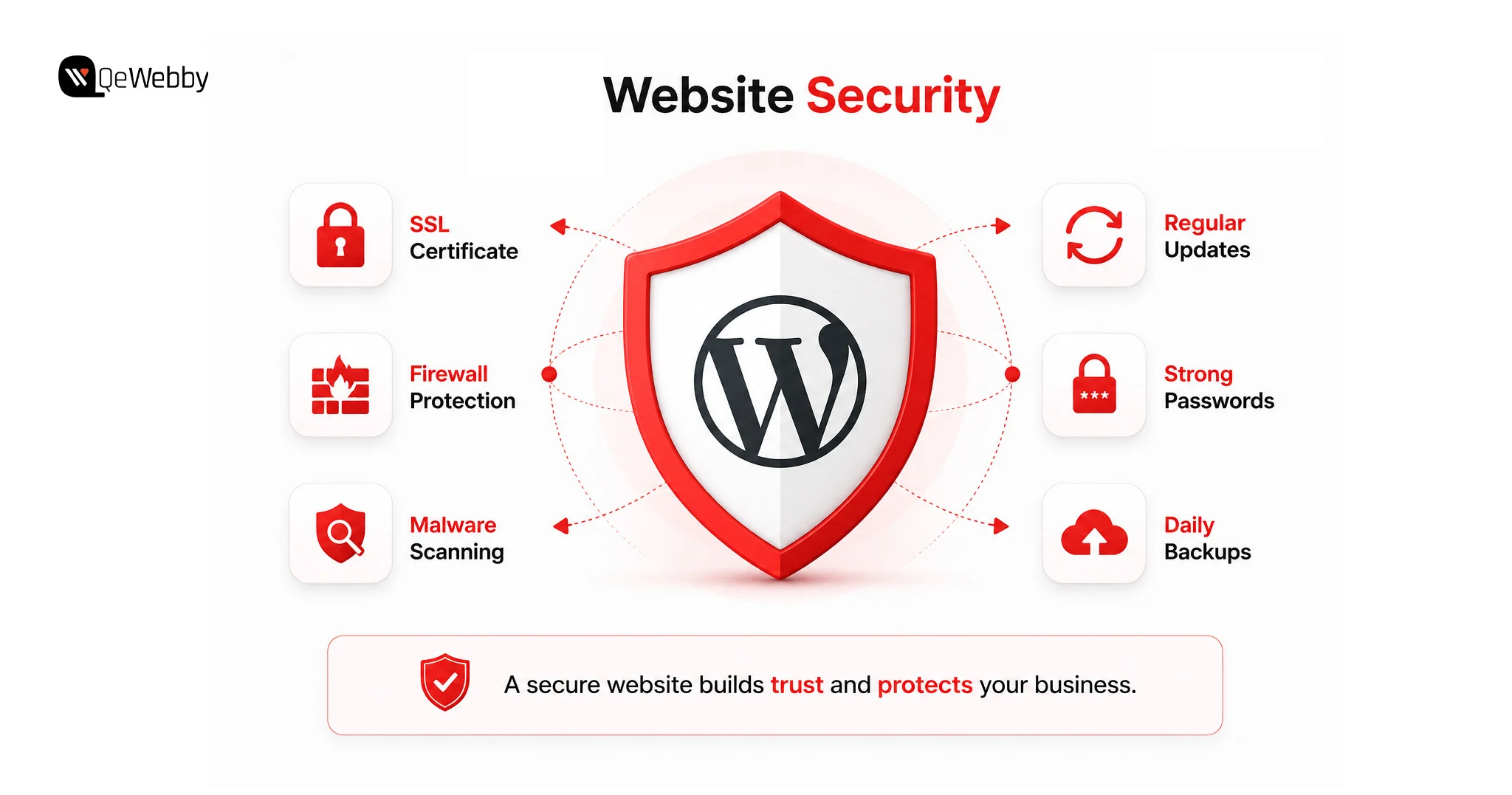
The good news is that WordPress security for small businesses doesn’t have to be expensive. In fact, most of the protection your website needs is completely free.

This free WordPress security checklist shows you how to secure your WordPress website for free using trusted plugins, built-in WordPress settings, and simple best practices. No coding. No premium software. Just practical steps that every small business owner can implement today.

Why Are Small Businesses Vulnerable to Cyberattacks?

Most cyberattacks don’t begin with someone choosing a specific business to target. They begin with automated bots scanning thousands of WordPress websites for common weaknesses.

Before diving into the free WordPress security checklist, it’s important to understand why WordPress security for small businesses deserves immediate attention.

The Dangerous Myth That Small Sites Are Safe

Many business owners believe hackers only pursue high-profile companies. In reality, automated bots scan millions of WordPress websites every day, searching for weak passwords, outdated plugins, vulnerable themes, and exposed login pages. They don’t evaluate business size.

What a Hack Actually Does to a Small Business

A compromised WordPress website can do far more than display unwanted content. Attackers may steal customer information, inject malware, redirect visitors to fraudulent websites, or trigger Google’s security warnings that remove your pages from search results. Even a single outdated plugin has cost small businesses thousands in recovery expenses, lost revenue, and damaged customer trust.

The Good News: Free Security Covers Most Small Business Needs

The encouraging part is that effective security doesn’t have to be expensive. Regular updates, strong passwords, free WordPress security plugins, free WordPress malware protection, and free WordPress two-factor authentication stop the majority of common attacks. Spend one afternoon implementing the right measures, and your website instantly becomes far more difficult for automated bots to compromise.

No Free Security

The Complete Zero-Cost WordPress Security Checklist

A secure website isn’t built with one tool. It’s built through small, consistent improvements. Complete the following free WordPress security checklist to strengthen WordPress security for small businesses using trusted free tools and settings that take only minutes to configure.

1. Keep WordPress, Themes & Plugins Updated

Every WordPress update strengthens your website against newly discovered vulnerabilities. Keeping your core files, themes, and plugins updated reduces the chances of malware infections, unauthorized access, and compatibility issues. It’s one of the easiest yet most effective ways to improve WordPress security for small businesses without spending anything.

Why It’s Necessary

  • Closes known security vulnerabilities before hackers exploit them.
  • Protects your website from malware and automated attacks.
  • Improves plugin compatibility and website stability.
  • Keeping your website optimized also improves performance. Our WordPress Speed Optimization Services help businesses maintain both security and loading speed.

In Verizon’s 2024 Data Breach Investigations Report, 14% of data breaches involved the exploitation of vulnerabilities as the initial access method, nearly three times higher than the previous year. Hackers don’t need sophisticated techniques if websites aren’t patched. That’s exactly why updating WordPress, plugins, and themes every week should be your first security habit.

2. Install Wordfence Free: One of the Best Free Security Plugins

A good security plugin acts like a gatekeeper for your website. Wordfence provides WordPress malware protection for free, a free WordPress firewall, login monitoring, and WordPress brute force protection, making it one of the most comprehensive free security solutions available.

Why It’s Necessary

  • Blocks suspicious traffic before it reaches your website.
  • Scans files for malware and security issues.
  • Limits repeated login attempts from bots.
  • Combines multiple security features into one plugin.
  • Reduces plugin conflicts by replacing several separate security tools.

3. Enable Two-Factor Authentication on Every Admin Account

Passwords can be guessed, leaked, or stolen, but two-factor authentication adds another layer of protection. Even if someone knows your password, WordPress two-factor authentication free prevents unauthorized access by requiring a second verification step.

Why It’s Necessary

  • Protects administrator and editor accounts.
  • Prevents unauthorized dashboard access.
  • Reduces risks from stolen passwords.
  • Adds security without affecting everyday usability.

According to Verizon’s 2024 DBIR, 68% of breaches involved a human element, including stolen credentials, phishing, or user errors. Technology alone can’t secure a website. Strong passwords, two-factor authentication, and good security habits often make a bigger difference than expensive software.

4. Change the Default WordPress Login URL

The default WordPress login page is one of the first places automated bots try to access. Changing it to a custom URL adds another layer of WordPress login protection, free, making your website a far less obvious target for brute force attacks.

Why It’s Necessary

  • Reduces automated login attempts targeting /wp-admin.
  • Makes your login page harder for bots to discover.
  • Adds an extra security layer without affecting legitimate users.
  • Prevents unnecessary server load caused by repeated login requests.

5. Use Strong Passwords and a Free Password Manager

Even the best security setup can fail because of a weak password. Long, unique passwords generated with tools like Bitwarden or WordPress’s built-in password generator dramatically reduce the risk of unauthorized access while making account management much easier.

Why It’s Necessary

  • Prevents attackers from guessing or cracking passwords.
  • Reduces the risk of credential reuse across multiple websites.
  • Stores complex passwords securely in one place.
  • Makes password management simple without sacrificing security.
  • Protects every user account, not just administrators.

6. Set Up SSL and Force HTTPS

An SSL certificate protects the data exchanged between your website and its visitors by encrypting every connection. Most hosting providers offer free SSL certificate through Let’s Encrypt, allowing you to improve security and build visitor trust in just a few minutes.

Why It’s Necessary

  • Encrypts sensitive information during transmission.
  • Displays the secure padlock icon in modern browsers.
  • Prevents data interception on public networks.
  • Supports better user trust and browsing confidence.
  • Meets Google’s recommendation for secure websites.

7. Set Up Automated Backups to Google Drive

Backups don’t stop cyberattacks, but they make recovery quick and stress-free. A recent backup allows you to restore your website after malware infections, failed updates, accidental deletions, or hosting issues without rebuilding everything from scratch.

Why It’s Necessary

  • Restores your website quickly after a security incident.
  • Protects your content from accidental data loss.
  • Stores backup copies away from your hosting server.
  • Automates backups to reduce manual effort.
  • Supports reliable WordPress backup free with cloud storage.

8. Disable XML-RPC

XML-RPC is rarely needed on modern WordPress websites, yet it remains a popular target for attackers. Disabling this unused feature removes a common attack vector and strengthens your website without affecting normal day-to-day functionality.

Why It’s Necessary

  • Blocks a frequently exploited attack method.
  • Reduces opportunities for brute-force login attacks.
  • Improves overall website security with a simple change.
  • Doesn’t affect most business websites or blogs.
  • Check with your developer if remote publishing is enabled.

9. Harden WordPress Files. No Code Knowledge Required

Strong security starts with secure website files. Basic WordPress file hardening practices, including disabling the built-in file editor and applying correct file permissions, reduce the chances of unauthorized changes while making your website more resilient against attacks.

Why It’s Necessary

  • Prevents unauthorized editing of plugin and theme files.
  • Reduces accidental code changes by users.
  • Limit file access using recommended WordPress file permissions.
  • Complements other security measures instead of replacing them.
  • Strengthens your website’s overall defense strategy.

10. Connect Google Search Console for Free Security Monitoring

Not every security issue is immediately visible. Google Search Console continuously monitors your website and notifies you about malware, phishing attempts, manual actions, and other problems that could impact your visitors and search visibility.

Monitoring search visibility is equally important. Our Technical SEO Services help identify indexing issues, crawl errors, and technical problems before they affect rankings.

Why It’s Necessary

  • Sends alerts when Google detects security issues.
  • Helps identify malware before rankings are affected.
  • Monitors manual actions and indexing problems.
  • Protects your website’s reputation and organic traffic.
  • Requires only a few minutes to set up and monitor.
  • Google also warns you if malware causes Safe Browsing issues.

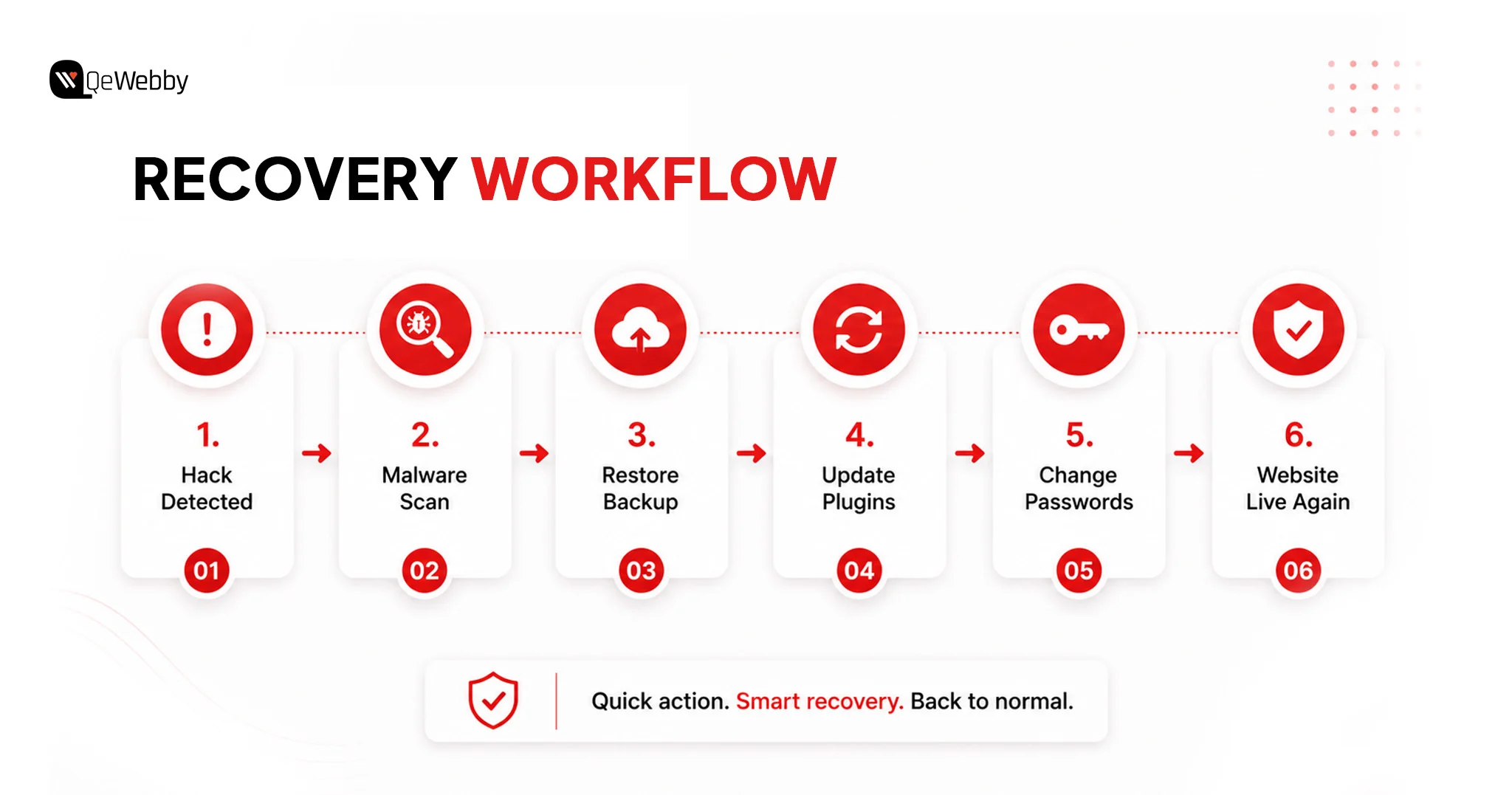
Recovery Workflow

3 Mistakes Small Business Owners Make With Free Security Tools

Installing free security tools is a great start, but using them incorrectly can create new problems. These are the three mistakes that leave many small business websites vulnerable, even when they believe they’re fully protected.

Mistake 1: More Security Plugins Doesn’t Mean More Security

Running multiple security plugins might seem like extra protection, but it often creates conflicts. One plugin’s firewall can interfere with another’s login protection, leading to false alerts, broken functionality, or even locking legitimate users out of the dashboard.

What to do instead

  • Install Wordfence as your primary security plugin.
  • Configure its firewall, malware scanner, and login protection correctly.
  • Avoid installing additional security plugins that perform the same tasks.

Mistake 2: Treating Security as a One-Time Setup

Many website owners secure their WordPress site once and never look back. Meanwhile, plugins receive updates, new vulnerabilities emerge, and your website gradually becomes less protected without you noticing.

What to do instead

  • Spend 15 minutes each month reviewing your security.
  • Update WordPress, plugins, and themes.
  • Check Wordfence scan reports.
  • Confirm that your automated backups completed successfully.

Mistake 3: Assuming Your Backup Will Work

A backup only has value if it can actually restore your website. Many businesses discover their backup is incomplete or corrupted only after a hack or server failure, when it’s already too late.

What to do instead

  • Download your latest backup once every quarter.
  • Perform a test restore on a staging website.
  • Verify that files, media, plugins, and the database restore correctly before you actually need them.

Book a free call

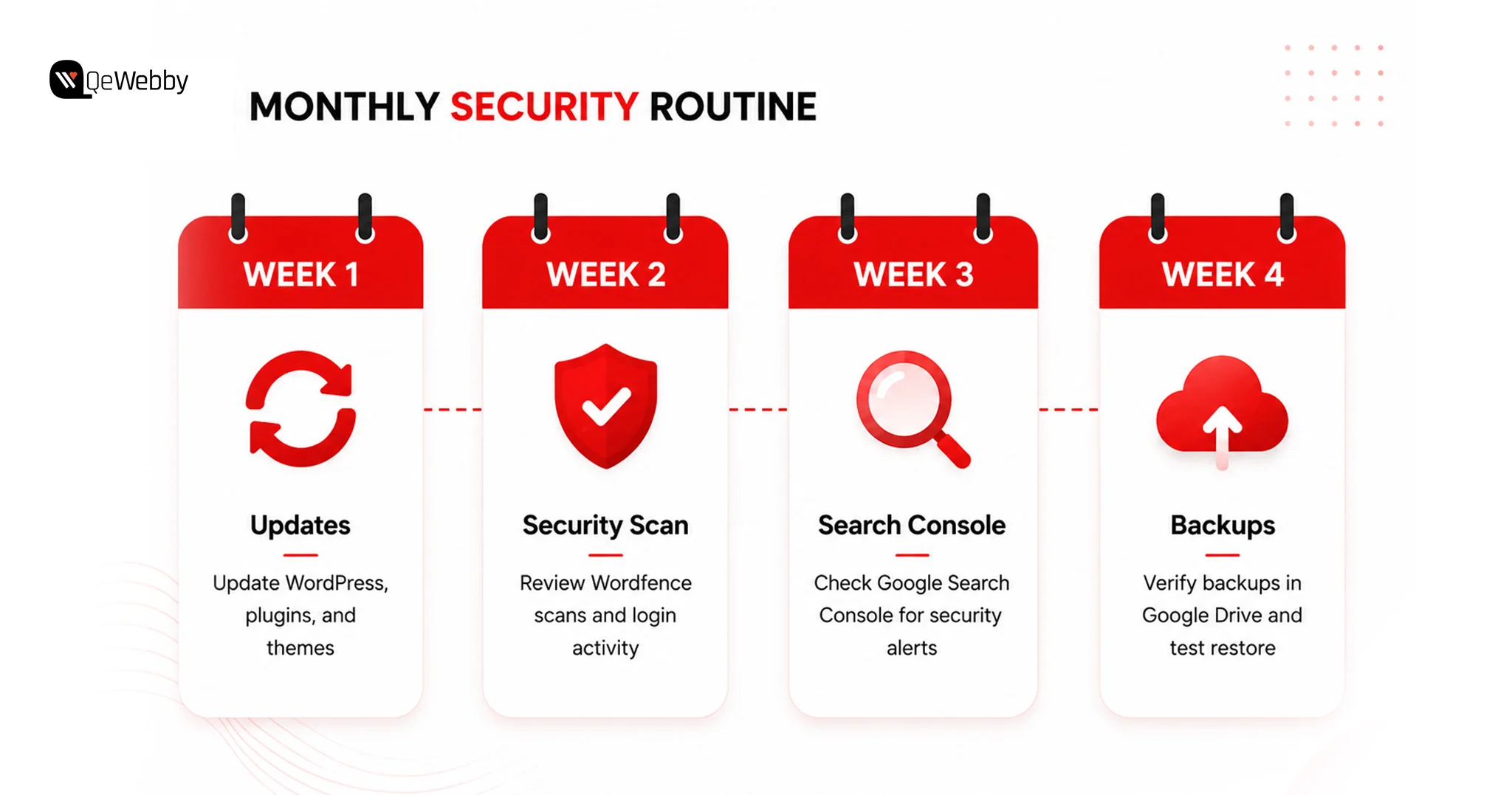
The Monthly 15-Minute Security Routine for Small Business Owners

The easiest way to maintain WordPress security for a small business is to spread small tasks across the month. Instead of spending hours fixing problems later, dedicate just a few minutes each week to keeping your website healthy.

Monthly Security Routing

How QeWebby Can Help You Secure Websites?

Every security layer needs to be configured correctly, monitored regularly, and maintained as your website evolves. QeWebby helps businesses build a stronger security foundation with practical solutions that keep websites protected, reliable, and easy to manage.

  • Security Setup: We configure essential WordPress security features, including firewalls, malware protection, login security, SSL, backups, and file hardening to reduce common vulnerabilities from day one.
  • Proactive Protection: Our team continuously follows security best practices, helping your website stay protected against emerging threats instead of reacting after an attack occurs.
  • Website Maintenance: With our WordPress website maintenance service, we handle updates, monitor website health, review backups, and ensure plugins and themes remain secure and compatible.
  • Performance & Security Balance: A secure website should also perform well. We optimize your WordPress environment to maintain speed, stability, and security without compromising the user experience.
  • Security Designed for Small Businesses: Our WordPress security service for small businesses is designed to provide enterprise-level protection in a practical and cost-effective way, giving growing businesses the confidence to focus on their customers instead of website security.

Conclusion

Website security isn’t just about preventing attacks. It’s about protecting your reputation, customer trust, and long-term business growth. A secure WordPress site protects your reputation, strengthens customer confidence, and supports consistent online growth, making it an essential part of your digital presence rather than just another maintenance task.

Our professional WordPress Development Services combine security, performance, and long-term website management to help businesses build reliable digital experiences.

If you’re ready to strengthen your WordPress website with confidence, contact us to discuss the right solution for your business.

Security Review

Top 8 WordPress Features to Include in Client Website

A client’s website launch day usually feels like the finish line.

The design is approved. The pages are live. The client is excited.

Then, two weeks later, the problems start.

This happens because many WordPress websites are built to look good, but they are not always prepared to perform.

According to Stanford Web Credibility Research, 75% of users admit they judge a company’s credibility based on its website design. However, credibility is only the first step. Website performance, usability, and functionality determine whether visitors continue engaging with the business.

A successful client website needs more than a modern design and a few pages. It needs the right foundation: security, speed, SEO, analytics, lead generation, and an easy management experience.

That is what separates a website that is simply published from a website that helps a client grow their business.

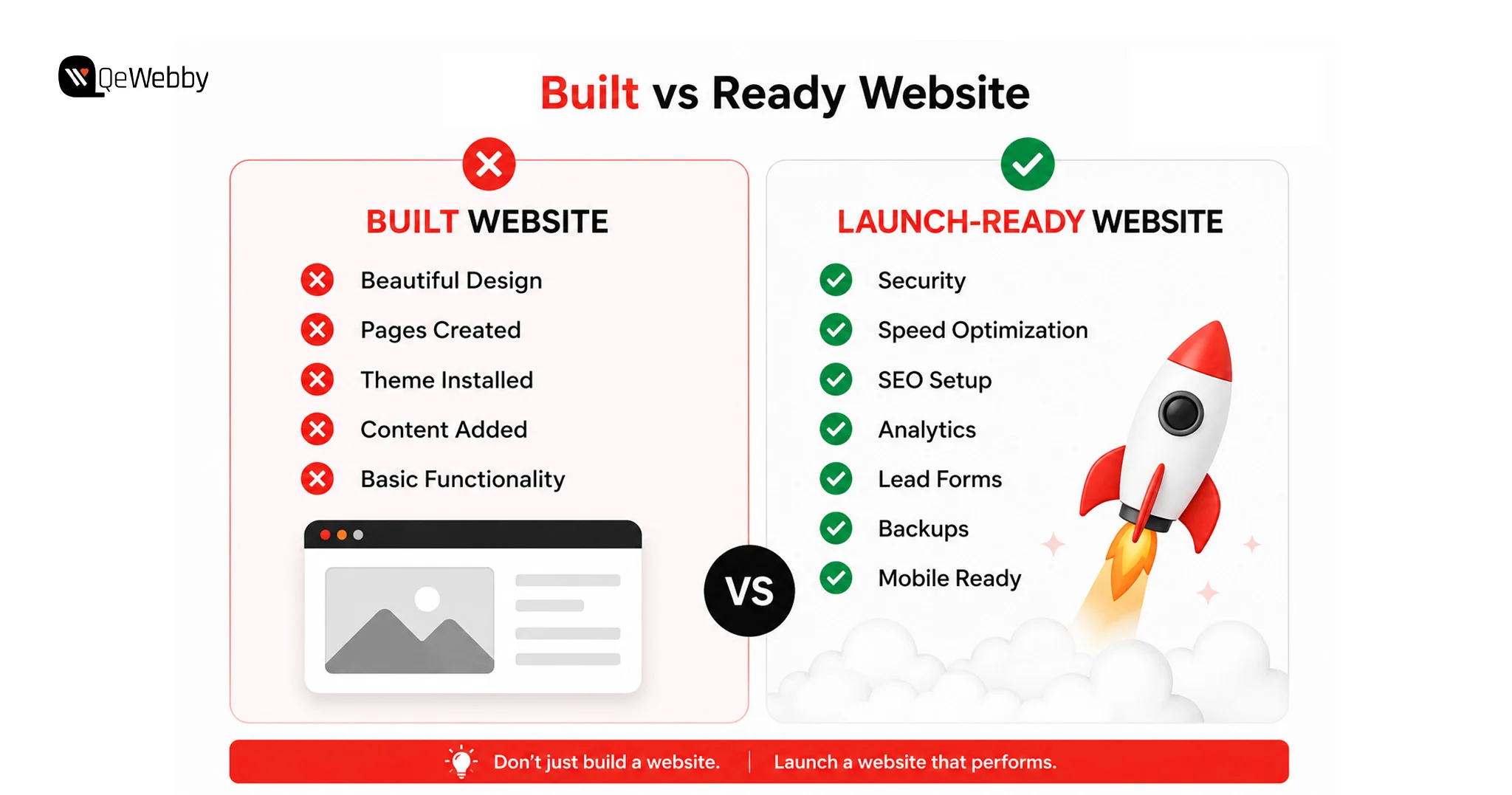
The Difference Between a Site That Is Built and a Site That Is Ready

There is a big difference between completing a website and preparing it for success.

A built website has:

  • Pages created
  • A professional design
  • Content uploaded
  • A working theme
  • Basic functionality

A ready website goes further.

It has:

  • Security protecting the website from threats
  • Speed optimization, keeping visitors engaged
  • SEO settings helping search engines discover pages
  • Analytics showing measurable results
  • Lead capture systems converting visitors
  • A client-friendly dashboard for easy updates
Built Ready Website

A complete WordPress development checklist for agencies should include everything needed for performance, usability, security, and long-term maintenance.

The 8 WordPress features below should be treated as a pre-launch checklist before any client website goes live.

8 WordPress Features Every Client Website Should Have

Feature Why It Matters
Secure login and user role management Protects the website while giving clients the right access
Client-friendly WordPress dashboard Makes website management easier after handoff
Speed and performance optimization Improves user experience and search visibility
Security and backup system Protects against data loss and website attacks
Mobile-responsive design Ensures the site works across devices
SEO foundation setup Helps Google understand and rank website content
Lead generation features Converts visitors into enquiries and customers
Analytics and reporting setup Shows whether the website is achieving results

Schedule a free consultation

Now let’s break down each feature.

#1. Login Setup

A WordPress website often starts with a simple mistake: giving clients more access than they actually need.

Most clients do not need full Administrator permissions.

When a client has complete admin access, they can accidentally:

  • Delete important plugins
  • Change theme files
  • Install conflicting tools
  • Modify settings that affect website performance

When something breaks, the developer is usually the first person they call.

A better approach is creating a secure WordPress client site setup where users only get access to the areas they actually manage.

For most clients, the Editor role is enough. They can update pages, publish content, and manage media without having access to critical website settings.

What Every Client Login Setup Should Include

Change the Default Login URL

The standard WordPress login page (/wp-admin) is targeted by automated bots.

Using a plugin like WPS Hide Login helps hide the default login location and reduces unnecessary login attempts.

Enable Two-Factor Authentication

Passwords alone are not enough protection.

Two-factor authentication adds another security layer by requiring users to verify their identity before accessing the dashboard.

Plugins such as WP 2FA make this easier to implement.

Limit Login Attempts

Repeated login attempts are one of the most common attack methods against WordPress websites.

Security plugins such as Wordfence can automatically block suspicious login activity and protect the client site.

Customize the Login Experience

A branded login page creates a more professional handoff experience.

Adding the client’s logo and removing unnecessary WordPress branding helps make the website feel like a dedicated business platform.

A secure login setup is one of the simplest WordPress security features for client websites, but it can prevent major problems later.

#2. Dashboard the Client Can Actually Use Without Calling for Help

The default WordPress dashboard is designed for developers, not everyday business owners.

After logging in, clients often see:

  • Plugin notifications
  • Theme settings
  • Developer tools
  • Technical options
  • Features they will never use

Too many options create confusion.

And a confused client usually means more support requests.

A client-friendly WordPress admin experience should make it easy for users to complete basic tasks without worrying about breaking something.

How to Create a Better Client Dashboard?

Remove Unnecessary Menu Items

Plugins like WP Adminify or Adminimize allow developers to hide:

  • Theme editor
  • Plugin settings
  • Technical tools
  • Unused dashboard sections

The client should only see what they need.

For example:

  • Pages
  • Posts
  • Media
  • Forms
  • Website analytics

Add a Welcome Guide

A simple welcome message can reduce future confusion.

Include:

  • Website update instructions
  • Important links
  • Contact information
  • A short training video

A five-minute Loom walkthrough can save hours of future support conversations.

Add Analytics Visibility

Clients want proof that their website is working.

Adding a dashboard analytics widget allows them to see:

  • Website visitors
  • Popular pages
  • Traffic sources
  • Leads generated

A well-organized dashboard improves the handoff experience and helps clients feel confident managing their website after launch.

#3. Speed Optimization

A website can have an impressive design, strong messaging, and all the right pages, but none of that matters if visitors leave before the page finishes loading. Research from Google shows that as page load time increases from 1 second to 5 seconds, the probability of a mobile visitor leaving increases by 90%.

Website speed is one of the first experiences users have with a brand. A slow website creates friction, reduces engagement, and can directly affect conversions. For businesses investing in a WordPress website, performance is not just a technical requirement; it is part of the customer experience.

Many developers focus heavily on design during the development phase and treat performance as something to fix later.

A proper WordPress speed optimization checklist ensures the website is built for performance from the beginning.

What Makes a WordPress Website Slow?

Most slow websites are not caused by one single issue. Performance problems usually come from multiple small factors working together.

Large image files increase page size. Too many plugins add unnecessary scripts. Poor hosting slows down server response times. Without caching, the website has to rebuild the same resources repeatedly for visitors.

The goal of optimization is not simply to achieve a better speed score. The goal is to create a website that feels fast and responsive for real users.
Optimize My Website

The Speed Setup Every Client Website Needs Before Launch

The first step is reducing unnecessary load on the website. Images should be compressed before uploading and converted into modern formats like WebP wherever possible. This reduces file size while maintaining visual quality.

Caching is another important part of performance optimization. A caching plugin stores frequently used website resources so pages can load faster instead of rebuilding everything with every visit. Tools like WP Rocket and LiteSpeed Cache are commonly used solutions for WordPress websites.

A Content Delivery Network (CDN) can further improve loading speed by delivering website assets through servers closer to visitors. Cloudflare is a popular option that also provides additional security benefits.

Before handing over the website, developers should always test performance using tools like Google PageSpeed Insights. This helps identify issues related to loading speed, mobile performance, and Core Web Vitals.

A fast website creates a better experience for visitors and gives clients a stronger foundation for SEO, conversions, and long-term growth.

Website speed improvements don’t end after launch. Regular performance audits help identify new bottlenecks caused by plugin updates, theme changes, or growing content libraries. Explore our WordPress Speed Optimization Services to keep your website fast as it grows.

#4. Security and Backups

Security is one of the most overlooked WordPress features for client websites.

A website can work perfectly for months and then suddenly face problems because of outdated plugins, weak passwords, malware, or failed updates. When that happens, the client does not see it as a technical issue. They see it as a business problem.

That is why security should be handled before launch, not after something goes wrong.

A professional WordPress client site setup should include both prevention and recovery. Protecting a website from threats is important, but having a reliable backup system is what helps restore operations quickly when unexpected issues occur.

Why Backups Should Be Ready Before Handoff

One of the biggest mistakes developers make is assuming clients will manage backups themselves.

Most clients are focused on running their business. They are unlikely to monitor backup schedules, check whether files are stored correctly, or test if a backup can actually restore the website.

A complete backup system should already be configured before the website is delivered.

Security plugins like Wordfence help protect websites through features such as firewall protection, malware scanning, and login monitoring. Automated backup solutions like UpdraftPlus help maintain copies of the website that can be restored when needed.

The backup location also matters. Keeping backups only on the same server as the website creates risk because a server issue can affect both the live site and the backup.

A reliable setup usually includes:

  • Automated scheduled backups
  • Off-site storage
  • Regular restore testing
  • Multiple recovery points

Beyond backups, basic security practices should also be completed before launch. SSL should be enabled, unnecessary plugins should be removed, administrator access should be limited, and features like the WordPress file editor should be disabled to reduce accidental changes.

For businesses that want ongoing protection after launch, a WordPress maintenance service for clients can provide continuous security monitoring, updates, backup checks, and technical support.

Website security requires continuous monitoring rather than one-time setup. Regular updates, malware scanning, uptime monitoring, and backup verification help keep your website protected long after launch. Learn how our WordPress Maintenance Services help businesses maintain secure and reliable websites.

#5. Mobile-First Design

A website that looks perfect on a desktop screen can still fail where many customers actually browse: mobile devices.

Mobile responsiveness is no longer an optional design feature. It is a core requirement of every WordPress website launch checklist. According to Statista, mobile devices generate more than half of global website traffic, making mobile optimization a core requirement rather than an optional improvement.

Visitors expect pages to load correctly, buttons to work easily, and content to remain readable regardless of the device they use.

Google also evaluates websites with a mobile-first approach, which means the mobile experience plays an important role in search visibility.

Why Mobile Testing Should Happen Before Launch

A common development mistake is building the entire website on a desktop and checking mobile only at the end.

This often creates avoidable problems.

A layout that works on a large screen may feel crowded on mobile. Buttons may become difficult to tap. Images may slow down the experience. Forms that work perfectly on desktops may become frustrating on smaller screens.

Testing mobile throughout the development process makes it easier to identify and fix these issues.

What Developers Should Review Before Delivery

Every important page should be tested on real devices, not only browser previews.

The homepage, service pages, contact forms, and conversion-focused sections should be checked to ensure:

  • Text remains easy to read
  • Navigation works smoothly
  • Buttons are easy to tap
  • Images display correctly
  • Forms function properly

Mobile speed should also be tested separately because performance on smartphones is often different from desktop.

A mobile-friendly website improves user experience, supports SEO performance, and helps clients avoid losing potential customers because of usability issues.

#6. SEO Foundation

A website launch is not complete when the pages go live.

It is complete when search engines can understand the website, users can discover it, and the business has a chance to attract organic traffic.

Many clients realize months after launch that their website is not generating visitors. The reason is often simple: SEO was considered a future task instead of part of the initial WordPress development checklist.

SEO needs to be built into the website foundation.

What Every Client Website Needs Before Going Live

The first step is configuring an SEO plugin such as Rank Math or Yoast SEO. These tools help manage important elements like metadata, XML sitemaps, and content optimization.

Every important page should also be reviewed before launch. The homepage, service pages, about page, and contact page should have clear titles, descriptions, proper heading structure, and content aligned with search intent.

Technical SEO settings also matter.

The XML sitemap should be submitted through Google Search Console so search engines can discover website pages efficiently. Schema markup should be added where relevant to provide more context about the business.

One simple setting can also prevent an entire website from appearing in search results. Developers should always confirm that the “Discourage search engines from indexing this site” option is disabled before moving a website from staging to live.

SEO is not something added after a website is finished. It is one of the core WordPress features that helps transform a website from a digital presence into a business growth tool.

Building a strong SEO foundation is only the beginning. Regular technical audits help identify crawl issues, indexing problems, broken links, and performance improvements that support long-term organic growth. Our Technical SEO Services help businesses maintain healthy, search-friendly WordPress websites.

#7. Contact Forms and Lead Capture

A client website is not built just to exist online. According to HubSpot, businesses that prioritize conversion optimization can significantly improve their ability to turn website visitors into leads. Small improvements in forms, CTAs, and user journeys can directly influence enquiry rates.

The website is built to help the business generate enquiries, bookings, sales, or conversations with potential customers.

This is where many websites fail.

They look professional, have impressive designs, and contain all the right information, but they make it difficult for visitors to take the next step. A missing contact form, unclear call-to-action, or broken enquiry process can turn valuable traffic into lost opportunities.

Lead generation should be treated as one of the most important WordPress features for client websites because it directly connects website performance with business outcomes.

Why Lead Capture Should Be Part of the Website Foundation

A common mistake is treating contact forms as a simple page element instead of a conversion system.

A well-designed website guides visitors toward action. It answers their questions, builds trust, and makes contacting the business simple.

For example, a visitor who lands on a service page should not have to search through the website to find a way to connect. The next step should be clear.

A strong lead capture setup includes more than just adding a form. Developers should consider where the form appears, what information it collects, how submissions are handled, and whether the client receives notifications properly.

Before handoff, every form should be tested from the user’s perspective.

Does the form submit correctly?

Does the client receive the enquiry?

Does the visitor get confirmation?

Small details like these often determine whether a website becomes a business tool or just an online brochure.

The Lead Generation Setup Every Client Website Needs

For most businesses, a simple and effective form works better than a complicated one.

Forms should collect only the information required to start a conversation. Asking for too many details can discourage visitors from completing the submission.

Plugins such as WPForms and Gravity Forms provide flexible options for creating professional contact forms.

A complete setup should include:

  • A clear call-to-action placed on important pages
  • Confirmation messages after submission
  • Email notifications for the client
  • Mobile-friendly form design
  • Conversion tracking for submissions

Adding options like WhatsApp contact buttons can also improve accessibility, especially for businesses that receive customer enquiries through mobile devices.

A website’s success is not measured by how many people visit it. It is measured by what those visitors do next.

#8. Analytics and Reporting

One of the biggest challenges after launching a website is proving that it is working.

Clients often ask:

“How many people are visiting?”

“Which pages are getting attention?”

“Are we receiving leads from the website?”

Without analytics, these questions become difficult to answer.

That is why the analytics setup should be completed before launch, not added months later.

A professional WordPress client website checklist should always include tracking systems that help measure performance from day one.

Why Analytics Matters After Website Launch

A website without analytics is like running a business without knowing where customers come from.

Analytics provides insights into:

  • Visitor behaviour
  • Traffic sources
  • Popular pages
  • Conversion activity
  • User engagement

This information helps businesses understand what is working and where improvements are needed.

It also changes the client conversation.

Instead of discussing whether the website “feels successful,” developers and clients can look at actual data.

The Analytics Setup Every Client Site Needs

Google Analytics 4 should be connected before the website goes live. This allows businesses to start collecting visitor data immediately.

Tools like MonsterInsights make it easier for non-technical clients to view important information directly inside WordPress.

Google Search Console should also be connected because it provides valuable insights into search visibility, keywords, and website indexing.

The most important step is tracking conversions, not just visitors.

A client does not only need to know that 5,000 people visited the website. They need to know how many people filled out a form, requested information, or completed a valuable action.

For agencies offering a WordPress website development service, including analytics setup and performance reporting, creates additional value. Clients are more likely to invest in long-term improvements when they can clearly see results.

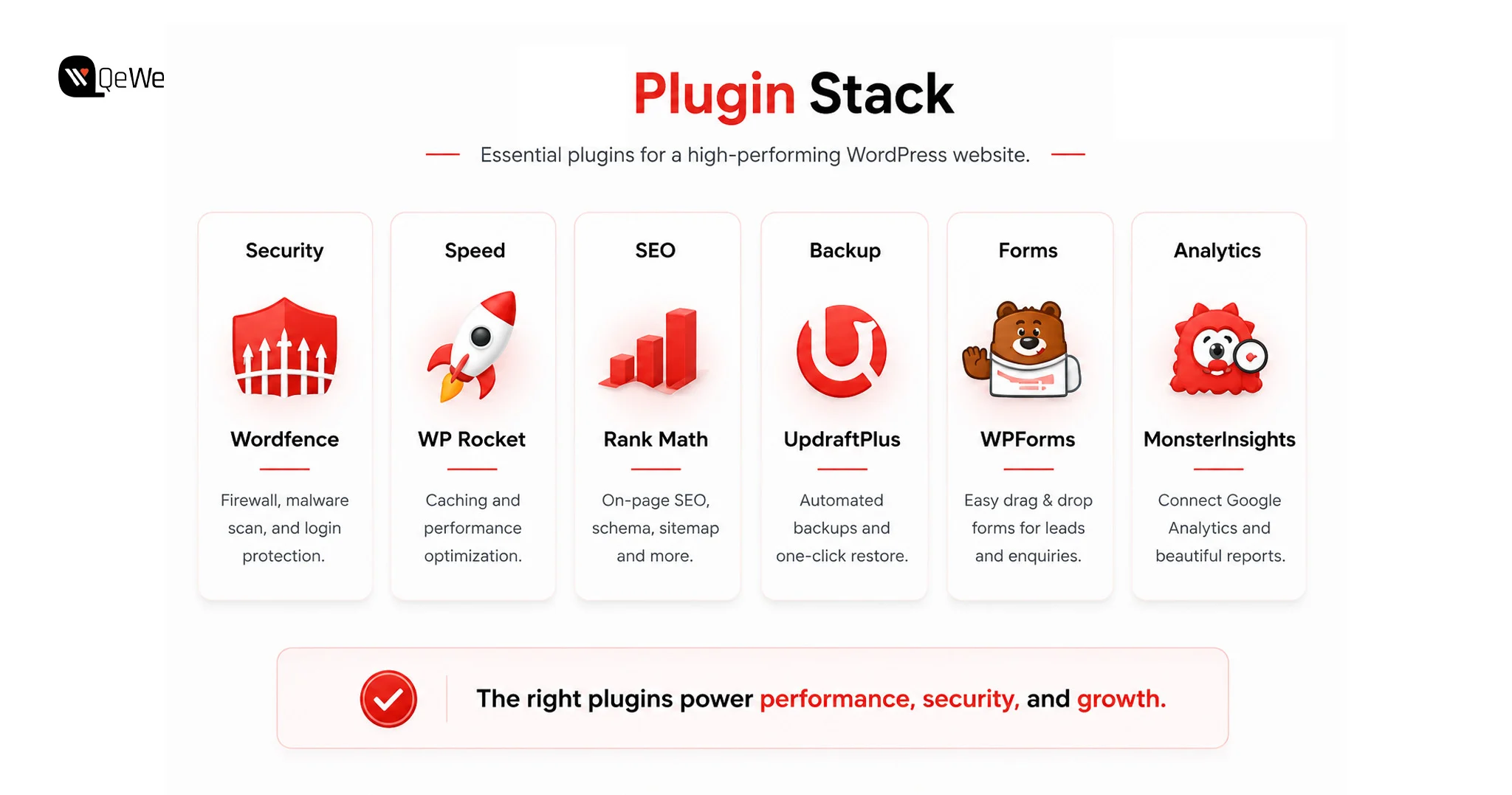
Recommended Plugins for a Complete WordPress Client Website Setup

Choosing the right plugins is an important part of building reliable WordPress websites.

However, the goal should not be installing dozens of tools. Too many plugins can create maintenance issues, slow down the website, and make management more complicated.

A better approach is selecting plugins that solve specific business needs.
Plugin Stack

Website Need Recommended Plugin Options
Security Wordfence, Solid Security
SEO Rank Math, Yoast SEO
Speed Optimization WP Rocket, LiteSpeed Cache
Backups UpdraftPlus
Contact Forms WPForms, Gravity Forms
Analytics MonsterInsights, Google Site Kit
Login Protection WP 2FA, Loginizer
Dashboard Management WP Adminify, Adminimize

The right plugin stack supports the website without creating unnecessary complexity.

Mistakes Developers Make When Delivering WordPress Client Websites

Building a website is only one part of the job. The handoff process determines whether the client feels confident or frustrated.

Many common problems happen because important steps are skipped before delivery.

One mistake is focusing only on appearance. A beautiful website without SEO, analytics, security, or lead capture is incomplete.

Another mistake is giving clients unrestricted access without explaining what they should manage. Full administrator access may create unnecessary risks if users accidentally change important settings.

Ignoring maintenance planning is another missed opportunity. Websites require ongoing updates, security monitoring, and performance checks after launch.

A professional developer does not just deliver a website. They create a system that continues working after the project ends.

What Happens After You Hand Over the Website? The 30-Day Client Success Window

Most WordPress guides focus on building the website.

But the real test begins after launch.

The first month after handoff is when many client relationships are either strengthened or damaged.

During the first few weeks, clients usually experience similar challenges.

They log in and wonder where to make updates. They see plugin update notifications and are unsure whether clicking “update” is safe. They upload large images without understanding how they affect speed. Eventually, they ask whether anyone is visiting the website.

This is where proper preparation makes a difference.

Build WordPress Client Websites That Work Beyond Launch Day

A successful WordPress website is not defined by how it looks on launch day. It is defined by how well it supports the client’s business months later.

The strongest WordPress client websites combine design with the features that matter behind the scenes: security, speed, SEO, analytics, lead generation, and easy management.

Using this WordPress client website checklist before every launch helps developers deliver more reliable projects, reduce support issues, and create better long-term relationships with clients.

A website should not just be delivered.

It should be prepared to perform.
Talk to WordPress Expert

Conclusion

A successful website is not only measured by its launch but by how well it adapts as a business grows. The right foundation allows businesses to add new content, improve customer experiences, and make informed decisions without rebuilding everything from scratch. This is where strategic WordPress development makes a difference.

QeWebby helps businesses create WordPress solutions that are structured for performance, scalability, and easier management. With a focus on thoughtful development practices and business-driven outcomes, QeWebby enables clients to build websites that support their evolving digital needs.

Whether you’re launching a new website or improving an existing one, combining a structured WordPress QA Checklist, regular maintenance, and technical audits helps create a website that’s ready for long-term growth.

To discuss how you can create a website built for long-term success, contact us and explore the right WordPress solution for your business.
White Label WordPress Hosting & Support: The Hidden Recurring Revenue Model for Agencies

Winning new clients feels great. But what happens after the website goes live?

For many web design and development agencies, that’s where the revenue stops.

Months of prospecting, pitching, designing, developing, revising, and launching a website often result in a single payment. Once the project ends, the agency is back to finding its next client. It’s a cycle that creates inconsistent cash flow, unpredictable workloads, and constant pressure to sell.

Now imagine what if every website you built could continue generating revenue month after month, even years after launch.

Instead of treating hosting and maintenance as an afterthought, successful agencies are packaging them into recurring service plans. The result is a stable monthly income, stronger client relationships, and a business model that scales far more efficiently than relying on one-time projects alone.

Having an increased 5% customer retention can result in profits by 25% to 95%, as per the report by Bain and Company. So, this is why agencies are increasingly investing in recurring service models.

What Is White Label WordPress Hosting?

For many agencies, offering website hosting seems like the logical next step after delivering a WordPress website.

However, managing hosting infrastructure, server security, software updates, backups, and uptime monitoring requires technical expertise that most agencies would rather invest elsewhere.

White label WordPress hosting solves this challenge by allowing agencies to provide fully managed hosting services under their own brand while a specialized infrastructure partner handles the technical execution behind the scenes.

From the client’s perspective, every interaction remains with your agency. They receive hosting, maintenance, and technical support branded as your own service, while the white-label provider manages the servers, security, monitoring, and performance optimization invisibly.

How Does White Label WordPress Hosting Work?

The delivery model is straightforward.

  • The agency sells managed WordPress hosting as its own service.
  • Client websites are hosted on the white-label provider’s infrastructure.
  • The hosting partner manages all technical operations.
  • The agency continues to own the client relationship, communication, and billing.

This allows agencies to focus on strategy, development, and client growth while technical infrastructure is managed by specialists.

Why Clients Prefer Managed Hosting From Their Agency

Most business owners don’t want separate vendors for development, hosting, maintenance, backups, and technical support. They prefer working with one trusted partner who already understands their website. White label hosting allows agencies to deliver that experience without building their own infrastructure.

Why Recurring Revenue Has Become the Foundation of Scalable Agency Growth?

The economics of recurring revenue fundamentally differ from those of project-based services.

Instead of generating income only when new work is secured, recurring services establish a predictable revenue base that compounds as the client portfolio grows.

Every new client represents not only an immediate project opportunity but also a long-term revenue stream through hosting, maintenance, security, technical support, and ongoing website optimization.

Predictable monthly recurring revenue improves cash flow visibility, simplifies resource planning, and enables agencies to make hiring and investment decisions based on reliable income rather than anticipated project pipelines. As recurring revenue increases, agencies become less dependent on continuously replacing completed projects with new engagements.

Over several years, recurring hosting and support services often exceed the financial value of the original development project while requiring significantly lower acquisition costs.

The difference between the two business models is substantial.

Project-Based Revenue Recurring Revenue Model
One-time project income Predictable monthly recurring revenue
Continuous client acquisition required Existing clients generate ongoing revenue
Revenue fluctuates with the project pipeline Greater financial stability
Lower customer lifetime value Higher long-term account value
Limited post-launch engagement Continuous client relationship and upselling opportunities

White Label WordPress Support: The Missing Piece in Agency Retainers

Hosting keeps a website online, but long-term client satisfaction depends on much more than server availability. WordPress websites require continuous maintenance to remain secure, compatible, and optimized as plugins, themes, PHP versions, and the WordPress core evolve.

This is where white-label WordPress support becomes an equally valuable recurring service.

Rather than responding only when a client reports a problem, agencies can offer proactive website management as part of a monthly support plan. This transforms the agency’s role from project vendor to long-term technology partner while creating predictable recurring revenue.

Services Typically Included in White Label WordPress Support

A professionally managed support service commonly covers:

Service Business Value
WordPress core updates Maintains compatibility and security
Plugin and theme updates Prevents conflicts and vulnerabilities
Daily or scheduled backups Enables rapid disaster recovery
Malware scanning and removal Protects websites against cyber threats
Website uptime monitoring Detects downtime before users are affected
Performance optimization Improves loading speed and user experience
Technical troubleshooting Resolves website issues quickly
Monthly maintenance reports Demonstrates ongoing service value

By combining hosting with continuous support, agencies provide clients with a complete website management solution rather than a standalone hosting package.

Many agencies bundle WordPress maintenance services into the same monthly care plan, helping clients keep their websites secure, updated, and performing reliably while creating an additional recurring revenue stream.

Book a Free Consultation

Why Managed WordPress Hosting Has Become a Strategic Agency Service?

Over the past decade, websites have evolved from static digital brochures into mission-critical business assets. For many organizations, even a few hours of downtime, security compromise, or poor website performance can result in lost revenue and diminished customer trust.

As a result, businesses increasingly expect their agencies to manage not only website development but also the ongoing health of their digital platforms.

This shift has elevated white label managed WordPress hosting from an optional add-on to a strategic service offering.

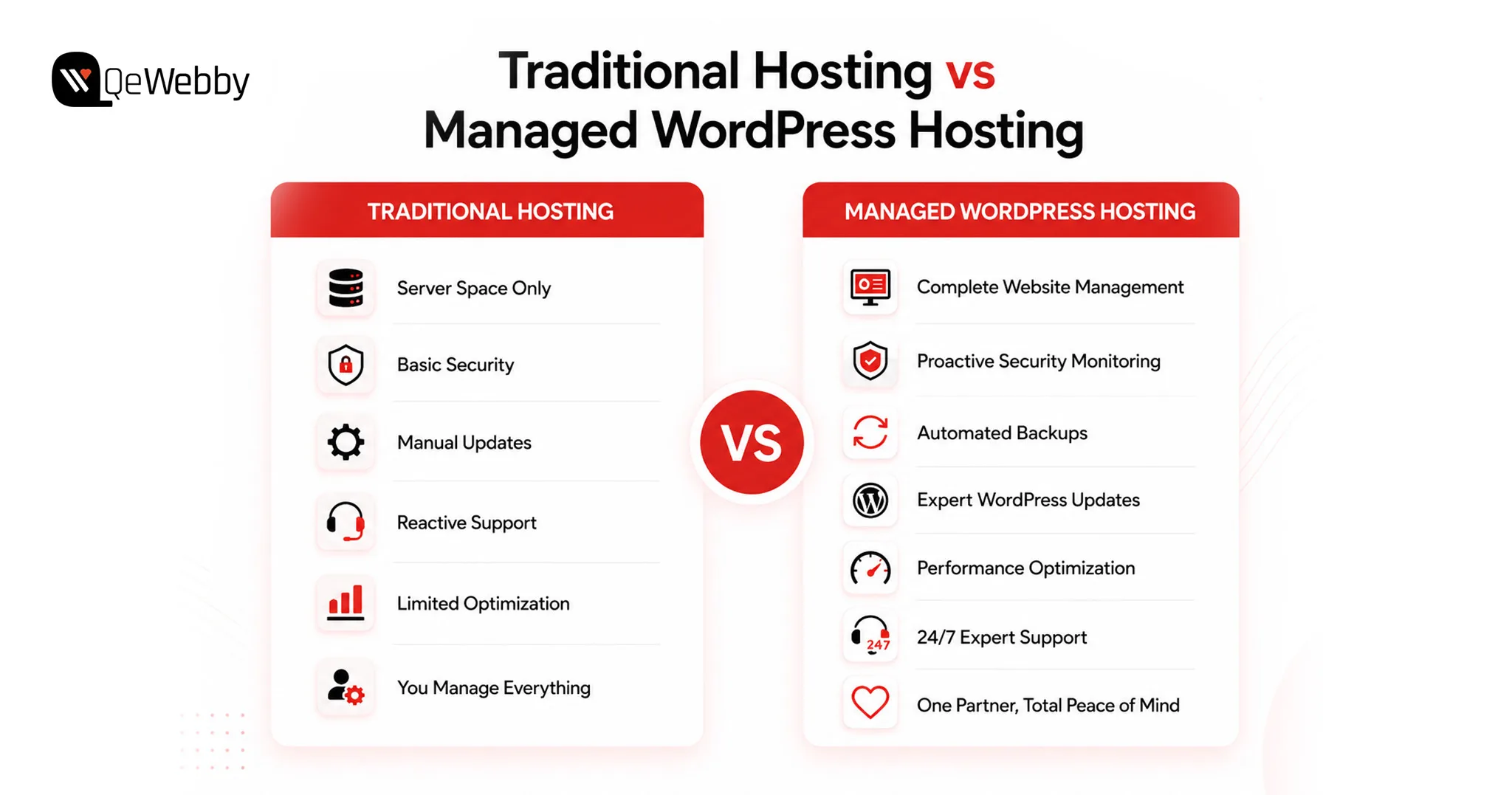
Unlike traditional hosting, managed hosting combines infrastructure, security, monitoring, maintenance, and performance optimization into a single solution. Clients benefit from a simplified experience with one trusted partner, while agencies strengthen long-term relationships through continuous service delivery.

The difference between traditional hosting and managed hosting illustrates why more agencies are adopting this model.

Traditional Hosting vs Managed WordPress Hosting

Traditional Hosting White Label Managed WordPress Hosting
Server space only Complete website management
Reactive issue resolution Proactive monitoring and maintenance
Client manages updates Updates managed by specialists
Limited optimization Continuous performance improvements
Basic security Multi-layer security monitoring
Separate maintenance providers Single integrated solution

For agencies, this integrated approach creates opportunities that extend far beyond hosting fees.

How Agencies Price White Label WordPress Hosting

Service Typical Monthly Fee
Hosting $25–$75*
Hosting + Maintenance $75–$150*
Premium Care Plan $150–$500+*

The exact pricing depends on website complexity, traffic, support requirements, and included services.

The Hidden Recurring Revenue Opportunity Most Agencies Overlook

Every website project represents more than a one-time development engagement. It also creates an opportunity to deliver ongoing services that clients will continue to require throughout the lifecycle of their website.

Unfortunately, many agencies stop at project delivery.

Once the website is launched, hosting is often outsourced to third-party providers, maintenance becomes reactive, and technical support is provided only when clients raise issues. In doing so, agencies unintentionally hand over a significant recurring revenue opportunity to hosting companies and managed service providers.

A more sustainable approach is to treat every website launch as the beginning of a long-term service relationship.

The progression typically looks like this:

Website Development

Managed WordPress Hosting

Website Maintenance

Security Monitoring

Technical Support

Performance Optimization

Monthly Reporting

Additional Digital Services

Each layer increases client value while creating another predictable revenue stream for the agency.

Over time, these recurring services often generate more cumulative revenue than the original development project itself. More importantly, they strengthen client retention because the agency becomes responsible for the ongoing performance, security, and reliability of the client’s digital presence.

Why Do Agencies Choose White Label Partners Instead of Building Everything In-House?

Offering managed hosting independently requires considerably more than purchasing server space. Agencies must also establish monitoring systems, backup processes, security protocols, disaster recovery plans, performance optimization workflows, and technical support capabilities.

Building and maintaining this infrastructure requires continuous investment in both technology and specialist expertise.

For many agencies, this approach introduces unnecessary operational complexity.

Partnering with a white-label WordPress agency offers a more efficient alternative. Instead of managing infrastructure internally, agencies leverage an experienced fulfillment partner while maintaining complete ownership of the client relationship.

The difference between the two approaches is substantial.

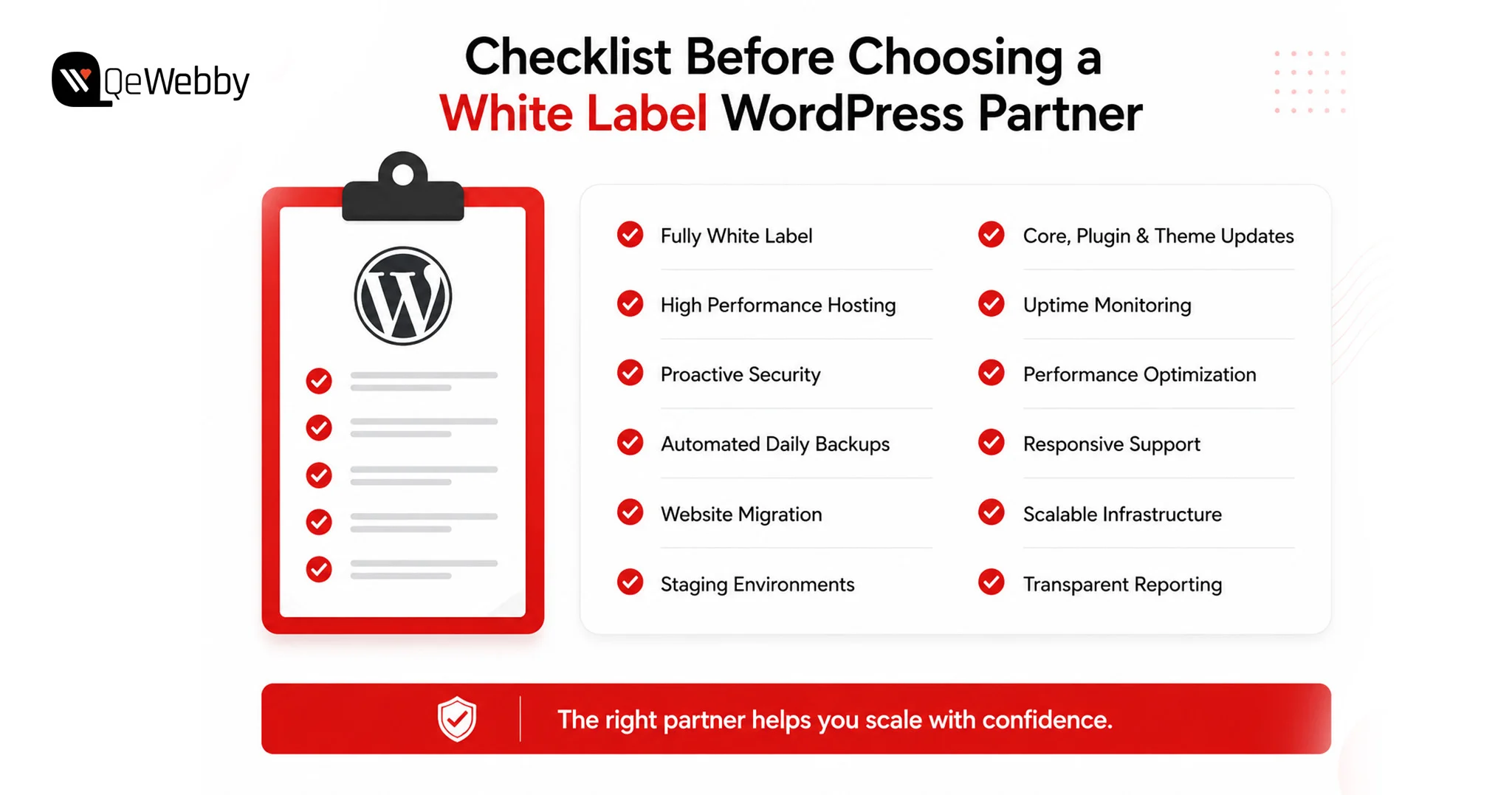
Checklist Before Choosing a White Label WordPress Partner

Managing In-House White Label WordPress Hosting
Invest in hosting infrastructure Infrastructure managed by partner
Hire server and security specialists No additional technical hiring
Maintain monitoring and backup systems Fully managed operations
Handle 24/7 technical issues Expert support team manages incidents
Higher operational overhead Lower operating costs
Longer service launch timeline Immediate market readiness

For growing agencies, this model enables faster expansion while minimizing operational risk. Internal teams remain focused on delivering high-value client work rather than managing hosting infrastructure.

What to Look for in a White Label WordPress Agency?

Not every hosting provider is designed to support agency growth. Selecting the right white label WordPress agency requires evaluating both technical capabilities and operational maturity.

The ideal partner should function as an extension of your agency, delivering enterprise-grade hosting and support while remaining completely invisible to your clients.

When evaluating providers, consider the following capabilities:

  • Fully white-labelled service delivery
  • High-performance managed WordPress hosting
  • Proactive security monitoring
  • Automated daily backups
  • Malware detection and removal
  • WordPress core, plugin, and theme updates
  • Website migration assistance
  • Performance optimization
  • Staging environments
  • Reliable uptime monitoring
  • Responsive technical support
  • Scalable infrastructure for growing client portfolios

Beyond technical expertise, agencies should also evaluate communication standards, service-level commitments, and the provider’s ability to support long-term growth.

How QeWebby Helps Agencies Build Predictable Recurring Revenue?

At QeWebby, we understand that agencies want to expand their service offerings without increasing operational complexity. Our white label managed WordPress hosting and white label WordPress support services are designed to help agencies achieve exactly that.

Rather than investing in infrastructure, technical resources, and ongoing server management, agency partners gain access to a fully managed WordPress environment delivered under their own brand.

  • Our services include:
  • Fully managed WordPress hosting
  • White-label WordPress maintenance
  • Security monitoring and malware protection
  • Daily backups and disaster recovery
  • Performance optimization
  • Website migration
  • Core, plugin, and theme updates
  • Technical troubleshooting
  • Continuous uptime monitoring
  • Scalable hosting infrastructure

Throughout the engagement, agencies remain the primary point of contact for their clients while QeWebby manages the technical execution behind the scenes.

Talk To Our Experts

Conclusion

Winning new projects will always matter, but predictable recurring revenue is what creates a sustainable agency. White label WordPress hosting and support transform every website launch into a long-term business relationship, allowing agencies to increase client lifetime value while reducing dependence on constant project acquisition.

At QeWebby, we help agencies expand their capabilities with reliable white label WordPress hosting and support solutions that integrate seamlessly into their existing service portfolio.

Our expertise enables agencies to scale confidently while maintaining complete ownership of the client experience. Contact us to explore how we can help you build a stronger recurring revenue model for your agency.

White Label AEO Services: The Strategic Advantages Agencies Cannot Afford to Overlook

Your clients are already asking the question. It showed up in a Q2 retainer review, phrased exactly like this: “Why does our competitor appear in ChatGPT answers, and we don’t?”

Here’s why it matters now. Zero-click searches hit 69% in 2025, up from 56% a year earlier. Google AI Overviews now appear on 13.14% of U.S. desktop queries. That number has doubled since January. When AI Overviews trigger, 83% of users never click through to any site.

The organic rankings your team reports every month still matter for commercial queries. But the informational layer is different. That’s where brand authority gets built. Where purchase decisions start. And that layer now belongs to AI-generated responses.

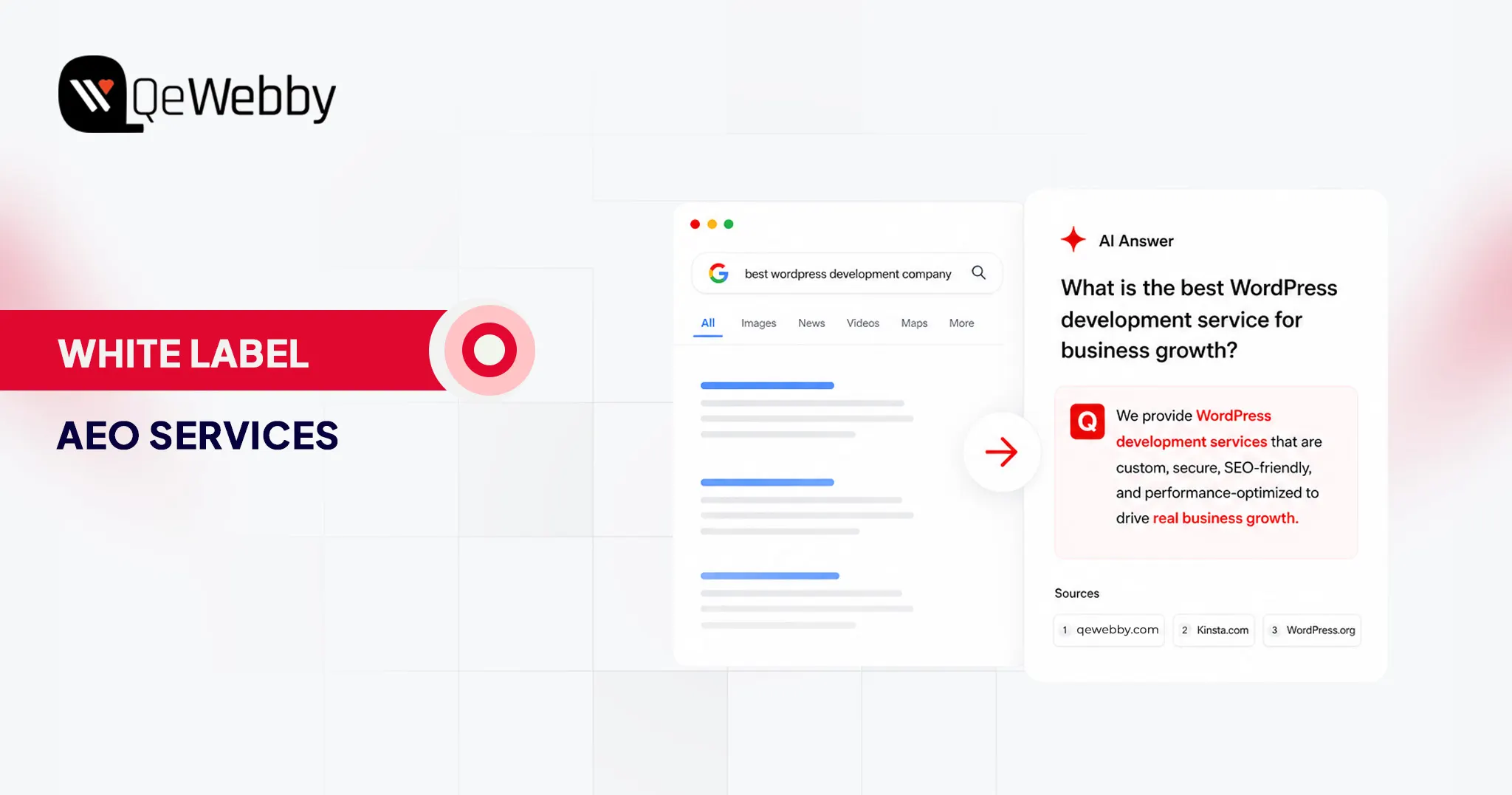
Answer Engine Optimization (AEO) structures content so AI platforms cite your clients’ brands as sources. White-label AEO services let you deliver that capability under your own brand without building specialist teams or tooling from scratch.

This piece breaks down the strategic, operational, and client-retention reasons for adopting white-label AEO. No pricing analysis. No margin math.

Why Agencies Cannot Defer the AEO Decision

Technology adoption cycles in digital marketing services are well-documented. Advantageous periods for new service categories typically last 18 to 24 months, after which the capability becomes a baseline expectation and competitive differentiation shifts to price. AEO is approximately 12 to 18 months into meaningful commercial availability as a service category.

65% of digital marketing practitioners identified AI-driven search changes as their single biggest challenge in 2026, according to a Goodfirms survey of 100-plus practitioners across 20 countries. Only 43% had actively implemented GEO or AEO strategies at the time of the survey.

That gap between problem recognition and active response is the operational window that agencies offering white-label AEO can close for their clients.

The competitive implication is direct. Agencies offering AEO in 2026 are positioning themselves as capability leaders. Those entering when AEO becomes standard practice will compete on price alone. The service category rewards early entrants with durable brand authority that late movers cannot replicate by simply launching the same offering in a saturated market.

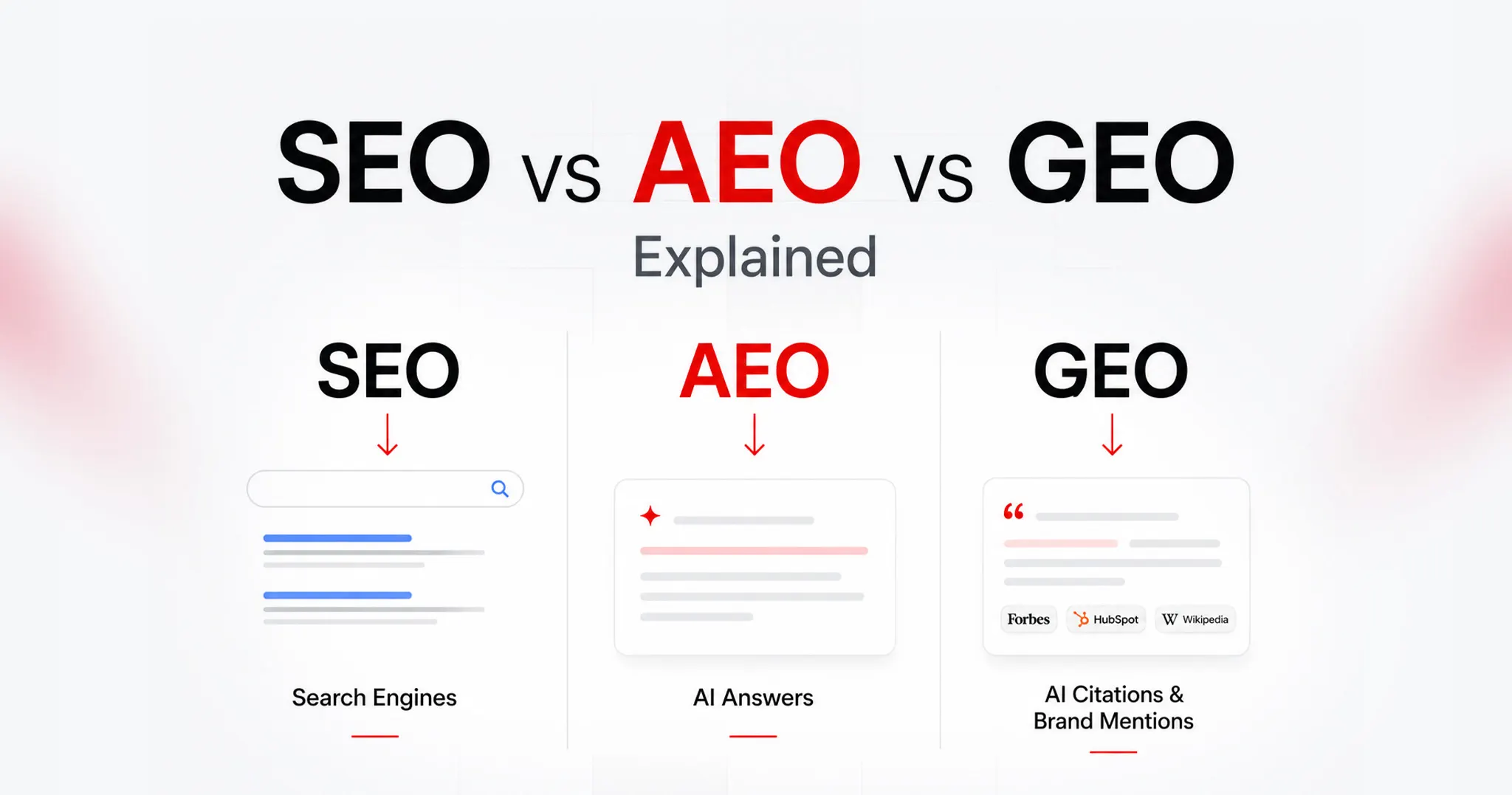
Dimension Traditional SEO AEO GEO
Target output Blue-link rankings in Google and Bing Featured snippets, AI Overviews, PAA boxes Brand citations in ChatGPT, Perplexity, and Gemini answers
Optimisation signal Backlinks, on-page factors, and Core Web Vitals E-E-A-T, schema markup, answer-first structure Topical authority, entity coverage, citation-worthy content
Measurement Rankings, organic traffic, CTR Snippet wins, PAA appearances, AIO share AI citation rate, brand mention monitoring across LLMs
Service maturity Established, high competition Growth phase, mid adoption Early stage, low saturation, high differentiation potential

The table above is not a theoretical framework. It reflects the actual service architecture that enterprise clients are increasingly requiring of retained agencies.

Six Strategic Benefits of White Label AEO for Agencies

The case for white-label AEO rests on six distinct operational and strategic advantages. Each operates independently of pricing considerations. Together, they represent a structural improvement in how agencies serve clients, retain accounts, and compete for new business.

Benefit What It Means for Your Agency Measurable Outcome
Instant capability Offer enterprise-grade AEO from day one without building specialist expertise in-house Faster service launch timeline
Complete service portfolio Address every client question about AI search visibility without referring work outward Higher contract value per retainer
Client retention protection Agencies with AEO retain clients at materially higher rates than SEO-only operations Stronger renewal conversations
Competitive differentiation Offer a capability most regional and mid-size agencies cannot deliver independently Improved new business win rate
Operational scalability Add new clients without proportional headcount growth or technical recruitment Preserved delivery margins
Early-mover positioning Establish authority before AEO becomes a commoditized baseline service Durable brand positioning

SEO Aeo Geo

1. Immediate Access to Specialist Capability Without Internal Recruitment

AEO requires a convergence of expertise that most generalist agencies lack on staff: schema markup architecture, answer-first content restructuring, entity authority building, and multi-platform AI visibility monitoring across ChatGPT, Perplexity, Gemini, and Bing Copilot.

Building this competency in-house requires dedicated recruitment, onboarding time, and ongoing investment in specialist tooling.

White-label AEO eliminates that runway. A white-label fulfillment partner absorbs that operational cost as part of the service structure. Your agency has access to the full capability stack from the first client engagement.

The practical consequence is a compressed time-to-market. An agency that decides today to offer AEO through a white-label partner can have a fully structured engagement delivered to its first client within one to two weeks.

An agency that decides to build the same capability internally faces a materially longer timeline before any client-facing delivery is possible.

2. Portfolio Completeness as a Client Retention and Acquisition Asset

Agencies with an incomplete service offering create referral risk. When a retained client asks about AI search visibility and the agency cannot address it, the conversation introduces a competitor into the account. QeWebby’s white-label marketing services are designed specifically to close that gap: agencies maintain a single point of contact for clients across the full search visibility spectrum, from traditional SERP optimization through to AEO and GEO.

Portfolio completeness also changes the nature of new business conversations. Prospects evaluate agencies not only on what they have delivered for comparable clients but also on the breadth of problems they can address in the future.

An agency that can present a unified strategy covering traditional SEO, featured snippet capture, and AI citation building occupies a structurally stronger position in a competitive pitch than one that leads with keyword rankings alone.

3. Measurable Improvement in Client Retention Rates

Client retention is the most direct indicator of service value in an agency business model. A clear retention gradient across service configurations: agencies delivering traditional SEO only report 72 to 78% retention, with the primary churn reason being clients citing a lack of AI visibility.

Agencies offering SEO with basic AI awareness report 82-87% retention. Agencies offering proactive, comprehensive AEO report the strongest retention performance in the cohort.

The mechanism behind that gradient is straightforward. Clients experiencing declining organic traffic are now aware that AI search behavior is a contributing factor.

An agency that can address that concern directly, with structured AEO deliverables and monthly reporting on AI citation rates, provides an evidence-based response to the question every client is beginning to ask. An agency that cannot address it creates an opening for a competitor that can.

The retention implication extends to renewal contract value. Clients who understand AI visibility as a measurable, improving outcome are more likely to authorize expanded scope and longer contract terms. This is not a marginal effect.

4. Competitive Differentiation in a Crowded Service Market

The differentiation value of AEO as a service offering is a function of supply, not demand. Demand is clear and growing. ChatGPT recorded 5.8 billion monthly visits in late 2025, with users sending 14 billion daily queries. Client awareness of these platforms as discovery channels is now mainstream.

Supply, however, remains constrained. Most regional and mid-size agencies lack the specialist expertise to execute AEO independently. The agencies that can credibly present AEO capability in a pitch, back it with a structured delivery methodology, and report against measurable AI visibility outcomes occupy a differentiated position that competitors without the capability cannot match on service grounds alone.

White-label delivery through a specialist partner like QeWebby provides the methodology, tooling, and delivery infrastructure that makes that credibility possible. The agency presents the capability. QeWebby executes it, invisibly, under the agency’s brand.

5. Operational Scalability Without Proportional Headcount Growth

The operational constraint that limits most agencies from launching new service lines is not a lack of capability. It is capacity. Adding a genuinely new technical service requires recruitment, training, process design, tooling acquisition, and quality assurance infrastructure before the first client deliverable can be produced. That sequence is time-consuming and operationally expensive.

White-label AEO removes that constraint from the equation. The fulfillment infrastructure, specialist team, tooling stack, and quality assurance process are part of the white-label partner’s operations. The agency adds AEO to its service portfolio and begins delivering it to clients without any of the internal scaling work that would otherwise precede the first engagement.

The scalability principle compounds. An agency that adds five AEO clients through a white-label model adds five retainer accounts without a corresponding increase in headcount, management overhead, or delivery risk. The same logic applies to ten, twenty, and beyond. QeWebby’s services infrastructure is built to absorb that scale, meaning the agency’s growth ceiling is not constrained by the white-label partner’s capacity.

6. Early-Mover Brand Positioning Before Market Saturation

Brand authority in a service category is built through consistent, visible execution before the category reaches saturation. Brands and agencies that establish entity authority before answer engines are saturated with optimized content accumulate more citations, which in turn build further authority. This dynamic rewards early movers with a compounding advantage that late entrants cannot replicate through volume alone.

The same dynamic applies at the agency level. An agency that is known in its market for AEO capability in 2026 is positioned differently from one that adds the service in 2028, when it has become a standard offering.

The former can speak to client outcomes, case evidence, and delivery methodology built over two years of active engagements. The latter is entering a commoditized market on the same footing as every other late adopter.

White-label delivery through QeWebby enables agencies to establish that positioning now, without the internal development timeline that building the capability independently would require. The brand authority belongs to the agency. QeWebby’s specialist team manages the execution infrastructure.

Differentiate Your Agency

What White Label AEO Actually Delivers: The Engagement Structure

Understanding the operational benefits of white-label AEO requires a clear picture of what a structured engagement includes. The following breakdown represents the standard deliverable framework QeWebby operates under for agency partners.

#1. AI Visibility Audit

Every engagement begins with a baseline audit. This establishes which queries in the client’s category currently trigger AI-generated answers across ChatGPT, Perplexity, Google AI Overviews, and Bing Copilot; whether the client brand appears in any of those answers; which competitors are being cited; and where structural content gaps prevent citation.

The audit output is branded to the agency and presented to the client as the evidence base for the engagement scope.

#2. Answer-First Content Restructuring

AI systems do not read full articles. They extract the first one to two sentences of each H2 or H3 section. Answer-first restructuring rewrites section openings so they lead with a direct, extractable answer. It adds definition blocks in the 40- to 60-word format that trigger featured snippet eligibility.

It introduces the FAQ schema for question-based content and the HowTo schema for process content. On a WordPress site, this restructuring integrates directly into existing page architecture without requiring a full content rebuild.

#3. Schema Markup Implementation

FAQ schema, Article schema, and HowTo schema form the machine-readable layer that signals content structure to AI crawlers. Without a structured schema, well-optimized content may not be correctly parsed by the AI systems that depend on structured signals to identify extractable answers.

Schema implementation is a technical deliverable that sits squarely within WordPress development competency, making it a natural complement to existing wordpress seo optimization service operations.

#4. Entity Authority Building

AI systems associate brands and practitioners with specific topic areas through entity relationships built from third-party citations, knowledge graph data, and cross-platform mentions.

Entity authority building creates and reinforces those associations: securing citations from sources that AI systems assign high trust weighting, building topical associations with the right industry entities, and ensuring the client’s knowledge graph profile is accurate and comprehensive.

This is the GEO layer of AEO work. It compounds over time and creates durable AI visibility that is significantly harder for a competitor to replicate than a schema update or content restructure.

#5. AI Visibility Monitoring and Reporting

Monthly reporting tracks featured snippet wins, PAA appearances, and brand citation rates across all major AI platforms.

This is the retainer-justification layer. Clients who receive a monthly report showing their AI visibility score improving quarter over quarter do not cancel.

The reporting cadence also provides the agency with a consistent touchpoint to discuss expanded scope, additional pages for restructuring, and new query categories as the client’s visibility footprint grows.

Is Your Agency Positioned to Add AEO? A Practical Readiness Assessment

The following indicators are not prerequisites. They are signals that the operational and commercial conditions for a successful AEO service launch are already in place. Two or more positive responses indicate that the structural conditions for a successful launch are in place.

  • Existing retainer clients have asked about AI search visibility or have questioned why their brand does not appear in AI-generated responses.
  • A client mentioned ChatGPT, Perplexity, or Google AI Overviews by name in a retainer review conversation in the past six months.
  • Retainer renewal conversations require more justification than they did 12 to 18 months ago, and declining organic click-through rates are part of that conversation.
  • The agency currently delivers wordpress seo optimization services and is positioned to add a complementary AI visibility layer to existing engagements.
  • New business pitches require a differentiation narrative that goes beyond keyword rankings, traffic volume, and content production capacity.
  • The agency wants to expand the addressable contract value per client without the recruitment and onboarding timeline required to build a new internal service line.

If two or more of these apply, the commercial and operational rationale for white-label AEO is already present in your client base. The question is not whether to offer AI visibility services. It is whether your agency is positioned to offer them before the competitive window narrows.

Become an Early aor Leader

Final Thoughts

White-label AEO is not a short-term revenue play. It is a structural response to a permanent shift in how consumers and B2B decision-makers discover, evaluate, and engage with brands. The agencies that build AEO capability into their service portfolio now, through white-label delivery or otherwise, are establishing a defensible position before the capability becomes a commodity.

The white-label model accelerates that positioning. It removes the internal development timeline. It provides immediate access to specialist tooling and methodology.

This allows agencies to compete on capability from the first client conversation, without waiting for an internal team to reach production readiness. Our white-label AEO services operate on exactly that model: your brand, your client relationship, QeWebby’s execution.

The search landscape your clients operate in has changed. The agencies that acknowledge that change and act on it now will be the ones leading retainer renewal conversations in 2027 from a position of demonstrated capability.

Complete WordPress & WooCommerce QA Checklist Before Website Launch

Launching a website isn’t just about going live. It’s about getting everything right before your audience ever clicks. When you’re working with both WordPress and WooCommerce, the stakes are even higher. A missed detail can break checkout flows, slow down pages, or hurt search visibility before you even start scaling.

That’s where a structured WordPress QA checklist becomes essential. It helps you validate performance, functionality, design consistency, and security across every page. At the same time, a focused WooCommerce site testing checklist ensures your product listings, cart behavior, payment gateways, and order workflows function exactly as expected. Why does it matter? Because, as per the reports, approx 50% of consumers will abandon their cart if the checkout process takes longer than 30 seconds.

Think of this as your pre-launch safety net. Without it, you are guessing. With it, you are systematically eliminating risks.

This blog brings together a practical, conversion-focused checklist designed specifically for WordPress and WooCommerce websites. Not generic tips. Real checks that impact revenue, user experience, and long-term growth.

If you want fewer post-launch issues, smoother transactions, and a site that actually performs from day one, this checklist will become your go-to framework.

Why Is a WordPress & WooCommerce QA Checklist Important Before Launch?

Launching without a clear QA process is risky. What looks perfect on the surface can quickly fall apart when real users start browsing, adding products to carts, or completing payments. WordPress and WooCommerce together create a powerful ecosystem, but they also introduce multiple layers where issues can hide.

A well-structured WordPress QA checklist ensures your website is technically sound. It helps you validate page speed, responsiveness, plugin compatibility, SEO readiness, and security. These are not optional checks. They directly influence how users interact with your site and how search engines rank it.

At the same time, a dedicated WooCommerce site testing checklist focuses on revenue-critical elements. Product pages must load correctly. Cart functionality should work without friction. Payment gateways need to process transactions smoothly. Even a small glitch here can lead to abandoned carts and lost sales.

This is where professional website QA testing services and WordPress QA services bring real value. They go beyond surface-level checks and uncover issues that are easy to miss internally. Broken workflows, inconsistent user journeys, or hidden performance bottlenecks can all impact your launch success.

A strong QA checklist is not just about avoiding errors. It is about delivering a seamless experience, building trust with users, and ensuring your WordPress and WooCommerce website performs the way it is meant to from day one.

QA Checklist for WordPress and WooCommerce Website Launches

A successful launch is never accidental. It is the result of a structured process where every element is tested, validated, and optimized before going live. This combined WordPress QA checklist and WooCommerce site testing checklist ensures your website is not only functional but resilient, scalable, and ready for real-world usage. It reflects how professional website QA testing services and WordPress QA services approach launch readiness.

WordPress Website QA Checklist

#1. WordPress Core Configuration

Configure site title, tagline, timezone, language, and permalink structure. Ensure canonical URLs and preferred domain formats are correctly set to avoid duplication. Validate reading settings, homepage display, and indexing visibility before going live.

Why does this matter?

Incorrect configurations can create SEO conflicts and tracking inconsistencies. A strong WordPress QA checklist ensures a clean and stable technical foundation.

#2. Essential Plugins

Install and validate plugins for security, backups, SEO, caching, and performance. Remove unused or outdated plugins and verify compatibility between active plugins and themes. Ensure plugin updates do not break existing functionality.

Why does this matter?

Plugin conflicts are one of the most common causes of failures. Website QA testing services focus on compatibility to maintain stability.

#3. Content Readiness

Review all core pages including homepage, about, contact, and policy pages for accuracy and completeness. Check formatting, internal linking, media rendering, and CTA placements across devices. Ensure there is no placeholder or duplicate content.

Why does this matter?

Incomplete or inconsistent content reduces credibility and engagement. WordPress QA services ensure your site is ready for real users.

#4. SEO and Analytics

Set up GA4, Google Search Console, XML sitemap, and robots.txt configuration. Validate meta tags, schema markup, and canonical tags to ensure proper indexing. Test event tracking and goal configurations for accurate reporting. These checks form the foundation of effective technical WordPress SEO.

Why does this matter?

Without proper tracking and indexing, performance cannot be measured. A WooCommerce site testing checklist often overlaps here to support growth tracking.

#5. Performance Optimization

Optimize images using WebP, enable caching, and configure CDN delivery. Minify CSS and JavaScript files and test Core Web Vitals across devices. Monitor server response time and eliminate render-blocking resources.

Why does this matter?

Slow performance directly impacts SEO and conversions. Investing in WordPress performance optimization before launch helps improve Core Web Vitals and user experience.

#6. Security Hardening

Enforce HTTPS across the site and configure firewall and login protection. Disable unused endpoints like XML-RPC and validate file permissions. Ensure admin access and roles are properly restricted.

Why does this matter?

Security gaps can lead to data breaches or downtime. WordPress security services ensure your website is protected from common vulnerabilities.

#7. Mobile Responsiveness and Cross-Browser Testing

Test layouts, navigation, and interactive elements across mobile, tablet, and desktop. Validate compatibility on browsers like Chrome, Safari, and Firefox. Ensure consistent UI behavior and touch responsiveness.

Why does this matter?

A broken experience on any device leads to immediate drop-offs. A complete WordPress QA checklist ensures consistency across platforms.

#8. Forms and Lead Capture Validation

Test all forms for submission accuracy, email triggers, and backend storage. Validate spam protection and integrations with CRM or email marketing tools. Ensure error handling works correctly.

Why does this matter?

Broken forms result in lost leads without visibility. Website QA testing services ensure data capture works reliably.

#9. Broken Links and 404 Handling

Scan for broken internal and external links and resolve redirects. Configure a custom 404 page that guides users back to relevant sections. Validate navigation paths across the website.

Why does this matter?

Broken links negatively impact SEO and user experience. WordPress QA services ensure smooth navigation and proper indexing.

#10. Accessibility and Compliance

Validate accessibility basics such as alt text, keyboard navigation, and contrast ratios. Ensure GDPR compliance through cookie consent and privacy policy visibility. Test usability for assistive technologies.

Why does this matter?

Accessibility improves usability and reduces compliance risks. Website QA testing services increasingly include these checks.

Wordpress QA Workflow

WooCommerce Website QA Checklist

#1. Store Setup

Configure currency, store location, tax display, and business details accurately. Validate regional settings and ensure they align with your target audience. Test storefront visibility and catalog configurations.

Why does this matter?

Incorrect setup leads to pricing and compliance issues. A structured WooCommerce site testing checklist ensures accuracy from the start.

#2. Product Listing

Add and validate product details including images, pricing, SKU, and inventory. Test variations, attributes, and structured data for proper display. Ensure consistency across category and product pages.

Why does this matter?

Product data directly impacts conversions and operations. WordPress QA services ensure product integrity and accuracy.

#3. Financial Configuration

Set up and test payment gateways, including success, failure, and refund scenarios. Validate transaction security, currency handling, and payment confirmation flows. Ensure logs are generated correctly.

Why does this matter?

Payment issues lead to direct revenue loss. Website QA testing services simulate real transactions to ensure reliability.

#4. Shipping and Tax Setup

Define shipping zones, methods, and tax rules based on business requirements. Test multiple scenarios, including international orders and edge cases. Validate real-time calculation accuracy.

Why does this matter?

Incorrect calculations can lead to financial discrepancies and customer dissatisfaction. WooCommerce site testing checklist ensures compliance and accuracy.

#5. Core Pages Functionality

Validate Shop, Cart, Checkout, and My Account pages for usability and performance. Test navigation flow, responsiveness, and page transitions. Ensure no broken elements exist across devices.

Why does this matter?

These pages define the entire buying journey. WordPress QA services ensure a seamless and frictionless experience.

#6. Transactional Emails

Configure and test all order-related emails for accuracy and branding. Validate triggers, delivery timing, and formatting across devices. Ensure links within emails function correctly.

Why does this matter?

Emails are critical for customer communication and trust. Website QA testing services ensure consistency and reliability.

#7. End-to-End Testing

Simulate complete user journeys from product selection to order completion. Test different payment methods, user roles, and edge cases. Validate refund, cancellation, and order tracking flows.

Why does this matter?

End-to-end testing uncovers issues missed in isolated checks. WooCommerce site testing checklist ensures real-world readiness.

#8. Cart and Checkout UX Optimization

Test cart updates, coupon application, guest checkout, and autofill behavior. Validate error handling and form validations during checkout. Ensure the process is fast and intuitive.

Why does this matter?

A complex checkout increases abandonment rates. WordPress QA services optimize this flow for better conversions.

#9. Coupon and Discount Logic Testing

Test various discount rules, including percentage, fixed, and conditional offers. Validate stacking rules, expiry conditions, and cart-level restrictions. Ensure correct price calculations.

Why does this matter?

Incorrect discounts impact margins and user trust. Website QA testing services ensure promotional accuracy.

#10. Inventory and Stock Management Validation

Test stock updates after purchases and validate backorder settings. Ensure low stock alerts and inventory sync with external systems. Monitor real-time stock behavior.

Why does this matter?

Inventory errors can lead to overselling or missed opportunities. WooCommerce site testing checklist ensures operational accuracy.

Talk To QA Specialist

How to Execute a WordPress and WooCommerce QA Checklist Effectively?

A checklist alone does not guarantee a smooth launch. Execution does. The difference between a stable website and a problematic one often comes down to how systematically you apply your WordPress QA checklist and WooCommerce site testing checklist.

Here is a practical way to approach it:

Start in a staging environment: Always test on a staging site before pushing changes live. This allows you to experiment, break things safely, and fix issues without impacting real users.

Prioritize critical workflows first: Focus on high-impact areas like homepage loading, product pages, cart behavior, and checkout flows. These directly influence conversions and user experience.

Test across devices and browsers: Run checks on mobile, tablet, and desktop. Validate performance on Chrome, Safari, and other major browsers to ensure consistency.

Validate integrations and dependencies: Plugins, payment gateways, and third-party tools should work together without conflicts. Even a small mismatch can disrupt the entire flow.

Simulate real user journeys: Don’t just click through pages. Add products to cart, apply coupons, complete payments, and test account creation. This is where most hidden issues surface.

Document and fix iteratively: Track every bug, prioritize fixes, and retest. Professional website QA testing services follow this structured loop to ensure nothing slips through.

Conclusion

A launch is not just a milestone. It is a reliability test in real conditions. What truly matters is how your website behaves when traffic, transactions, and user expectations collide at once. That is why a well-executed WordPress QA checklist and WooCommerce site testing checklist go beyond pre-launch tasks. They create a foundation for stability, scalability, and continuous improvement.

QeWebby brings a structured, engineering-led approach to website QA testing services, combining precision with real-world testing scenarios. Their WordPress QA services are designed to reduce risk while improving performance and user trust. If you are aiming for a launch that holds up under pressure, the right QA partner makes all the difference.

If you are planning your next launch or want to strengthen your QA process, contact us to build a more reliable WordPress and WooCommerce experience.

Request QA Audit